Apocrita
plural noun (n.pl.)
Definition
Apocrita, a suborder of holometabolous hymenopteran insects, includes bees, wasps, and ants. This taxonomic group is characterized by a distinctive morphological trait: the constriction between the thorax and the abdomen, commonly called a "wasp waist" or petiole. This structural adaptation gives them great flexibility and excellent mobility.
Ammophila rubripes is an apocritan:

Apocrita: apocritan hunting wasp Ammophila rubripes, a digger wasp of the family Sphecidae.
Explanations
Apocritans (Apocrita) are generally characterized by larvae that feed on other arthropods, including predatory species in which a larva feeds on multiple prey items and parasitoids in which the larva feeds on a single host individual.
Hymenopterans are divided into two suborders, Symphyta and Apocrita. Symphytans include sawflies and wood wasps, which feed on plants, and apocritans, which feed on pollen, nectar, and/or other arthropods.
The suborder Apocrita descends from an ancestral symphytan lineage. In adulthood, in Apocrita, the first abdominal segment is intimately fused with the thorax and separated from subsequent segments by a mobile constriction. This segment is called the propodeum. Thus, the locomotor tagma of the body, bearing the legs and wings, has four segments. The larvae are generally legless and very simplified in structure.
Apocritans are generally characterized by larvae that feed on other arthropods, including predatory species in which a larva feeds on multiple prey items and parasitoids in which the larva feeds on a single host individual. Parasitoids differ from parasites in that the host of the former is generally killed as a result of their feeding. Thus, ecologically, parasitoids function like predators, feeding on their host and ultimately killing it. The parasitoid life cycle is also found in the closest living relative of Apocrita within Symphyta: the family Orussidae.
However, many apocritan groups are secondarily phytophagous, consuming seeds or pollen or forming galls in plant tissues within which the larvae feed and develop.
Larvae of Apocrita exhibit a midgut closed at its posterior end that remains disconnected from the hindgut until pupation. This condition likely evolved as an adaptation of endoparasitoid ancestors of Apocrita to avoid releasing toxic metabolic wastes into the host in which they lived.
Synonyms, antonyms
Spanish translation: apócritos
2 synonyms (similar meaning) for "apocrita":
0 antonyms (opposite meaning).
Related words and expressions to APOCRITA are directly connected by general or specific meaning.
The word APOCRITA is listed on page 1 of words starting with A in the dictionary glossary.
Related to "Apocrita"
Hymenoptera
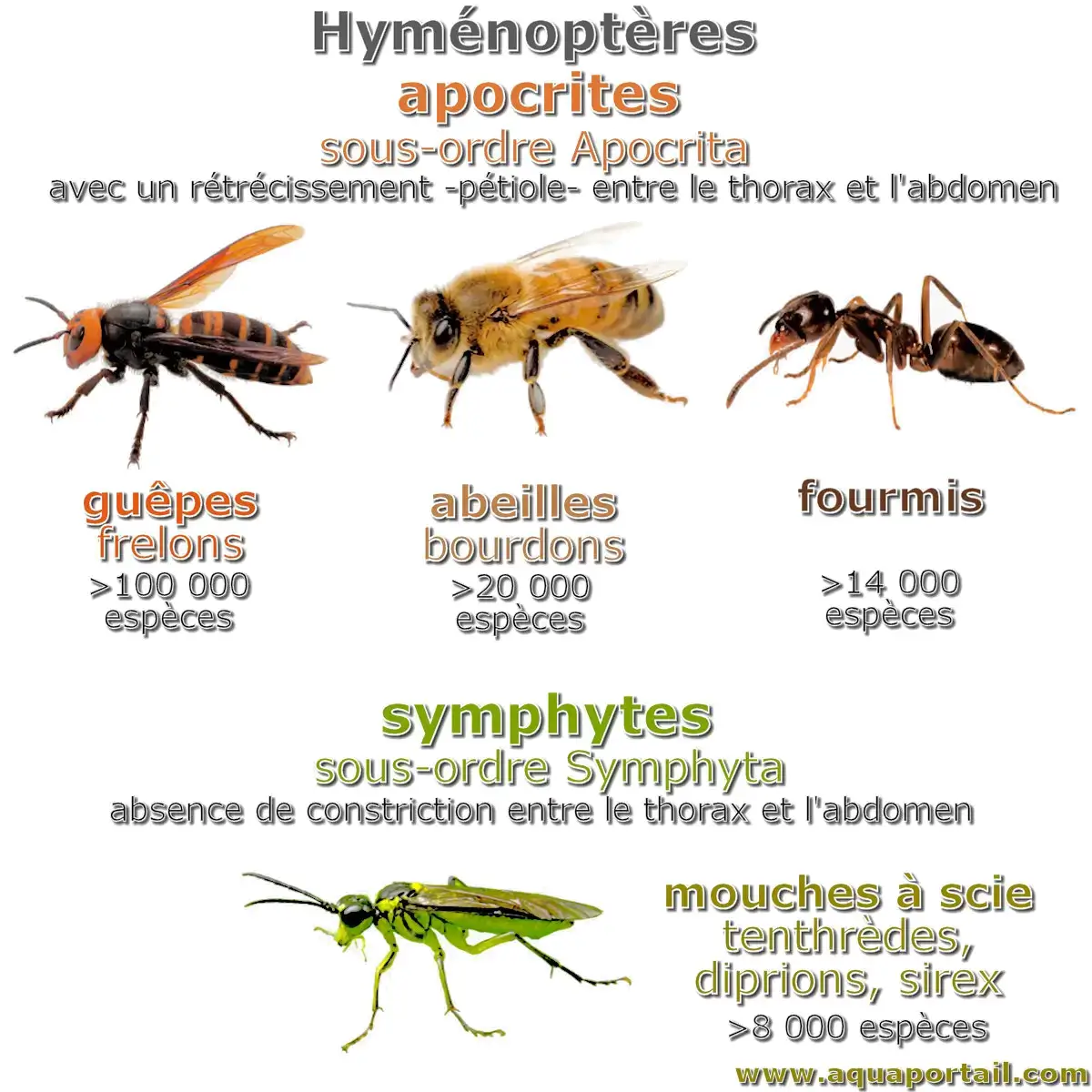
Hymenopterans, order Hymenoptera, are holometabolous insects with four membranous veined wings and a narrow waist (bees, wasps, ants, sawflies).
wasp

A wasp is an apocritan hymenopteran insect whose female possesses a venomous stinger. The best-known species is Vespula vulgaris, the yellow-and-black wasp...
abiotic

In biology and ecology, abiotic refers to what is not biotic, that is, not part of living beings.
aboral

Aboral refers to what is situated away from or opposite the mouth in zoology, and especially in marine biology.
Simple summary
Apocrita constitutes a suborder of the order Hymenoptera, encompassing a wide variety of insects, including wasps, bees, and ants. Apocritans generally exhibit complex social behaviors, highly specialized reproductive strategies, and diverse ecological roles, ranging from pollination to parasitism.
