Ether
noun (n.)
Definition
An ether is an organic compound consisting of an oxygen atom bonded to two alkyl or aryl groups. Its structure resembles that of alcohols, which in turn share structural similarities with water.
The general structure of ether:
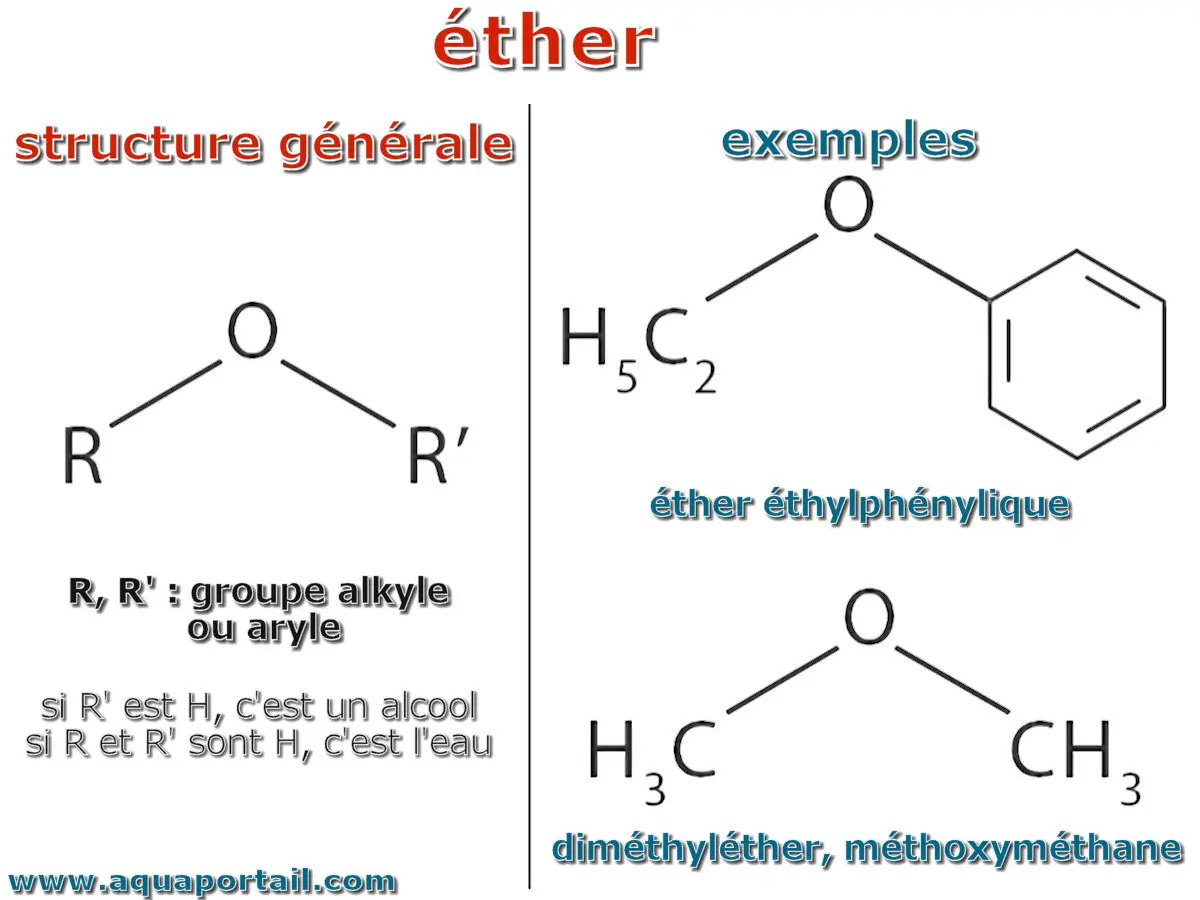
Ether has the general formula R-O-R′, where R and R′ are alkyl or aryl functional groups. If R′ is H (hydrogen), the compound is an alcohol; if both functional groups R and R′ are H, the compound is water. For example, methoxymethane (dimethyl ether) has the formula CH3-O-CH3.
Explanations
Ethers can be thought of as oxygen-bridged hydrocarbons with a sweet, slightly pungent odor.
At room temperature, ethers are generally colorless liquids that emit a sweet smell. The most common type of ether is diethyl ether. Highly flammable, it was among the first anesthetics used in surgery. This early use also LED to its misuse as an illicit substance, often taken for its sedative and euphoric effects. Consequently, ether (along with chloroform) gradually fell out of medical use following the introduction of newer inhalation anesthetics deemed safer and more effective.
Naming system
✅ In traditional nomenclature, common names of ethers are formed by placing the alkyl or aryl groups attached to the oxygen atom in alphabetical order, followed by the word ether. Thus, an ether with the molecular formula C2H5OC6H5 is commonly named "ethyl phenyl ether". When an ether contains oxygen atoms bonded to identical groups on both sides, Greek numerical prefixes such as di are used to indicate this uniformity before the name of the alkyl or aryl group. For example, the molecule CH3OCH3 is called "dimethyl ether".
✅ Under the nomenclature rules established by the International Union of Pure and Applied Chemistry (IUPAC), the choice of parent hydrocarbon is based on the alkyl or aryl group containing the largest number of carbon atoms. The subsequent group attached to the oxygen atom is indicated by the prefix oxy. For example, the molecule CH3OC2H5 is designated as "1-methoxyethane".
In physics
In physics, aether (or ether) is a 19th-century theoretical hypothesis (aether theory) proposing that a universal substance served as the medium for the propagation of electromagnetic waves, such as light or X-rays, much as sound waves require an elastic medium like air to travel.
Historically
Aether is the element once believed to fill the upper regions of space, likened to the heavens. It was the substance thought to fill the universe above the terrestrial sphere.
Synonyms, antonyms
French translation:
étherSpanish translation: éter
6 synonyms (similar meaning) for "ether":
0 antonyms (opposite meaning).
Related words and expressions to ETHER are directly connected by general or specific meaning.
The word ETHER is listed on page 1 of words starting with E in the dictionary glossary.
Related to "ether"
atmosphere

An atmosphere is a gaseous envelope surrounding a planet. The presence of an atmosphere around a planet depends on the gravitational pull it exerts...
E=mc2
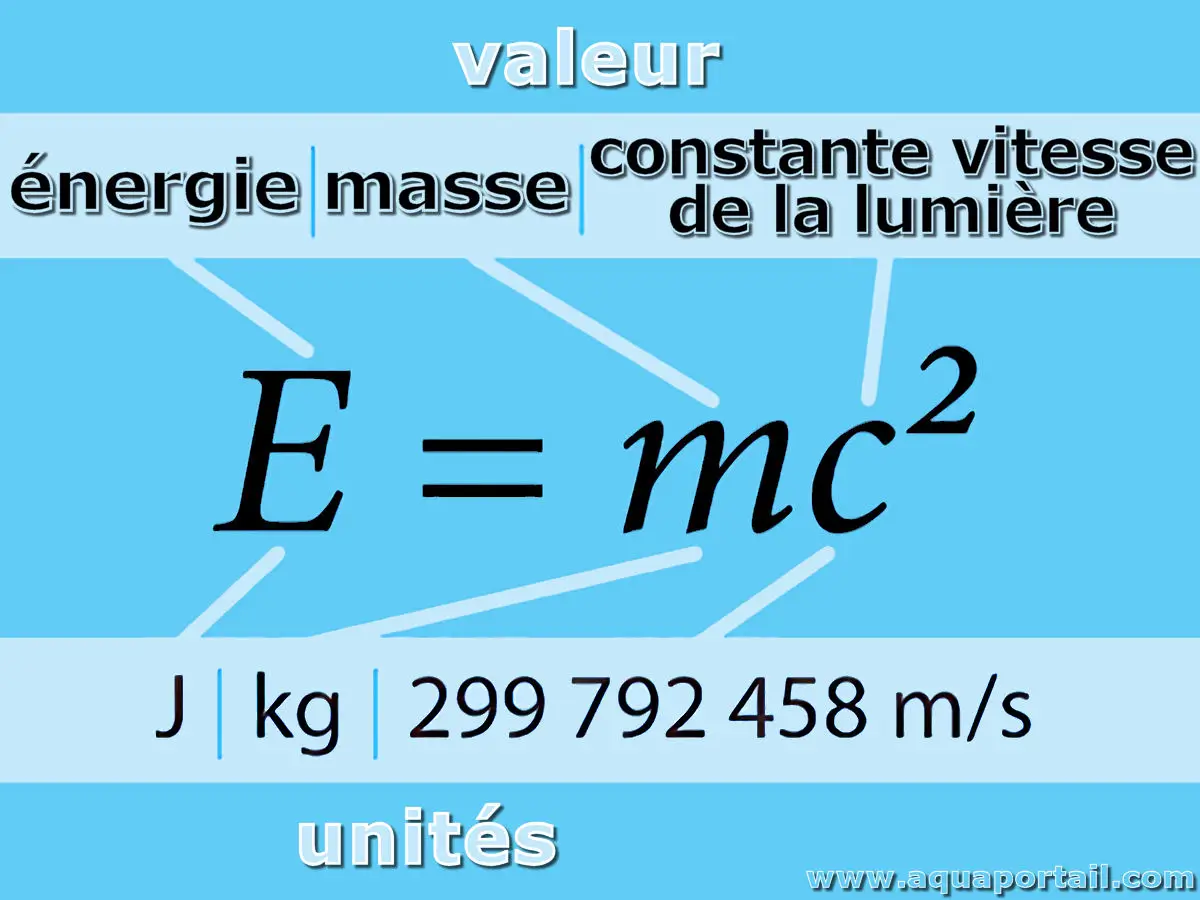
The formula E=mc2 (E = m. c²) is a mass-energy equivalence equation according to the theory of relativity developed by Albert Einstein. It expresses that...
ebb tide

Ebb tide designates the outgoing, falling tide of the sea that begins at high water, also known as reflux.
Ecdysozoa

Ecdysozoans, of the superphylum Ecdysozoa, are protostomes undergoing ecdysis within Bilateria.
