Urediniospore
noun (n.)
Definition
A urediniospore, or uredospore, is a thin-walled spore produced by the uredinium, a stage in the life cycle of certain fungal species such as rusts. The urediniospore is a dikaryotic structure having an n+n state. Consequently, it consists of two genetically distinct nuclei.
Urediniospores develop within the uredinium, usually on the underside of a leaf. Urediniospores typically have two nuclei (dikaryon) within a single cell. In mass, they are generally pale brown, unlike teliospores which are usually dark brown.
Urediniospores (uredospores) under the microscope:
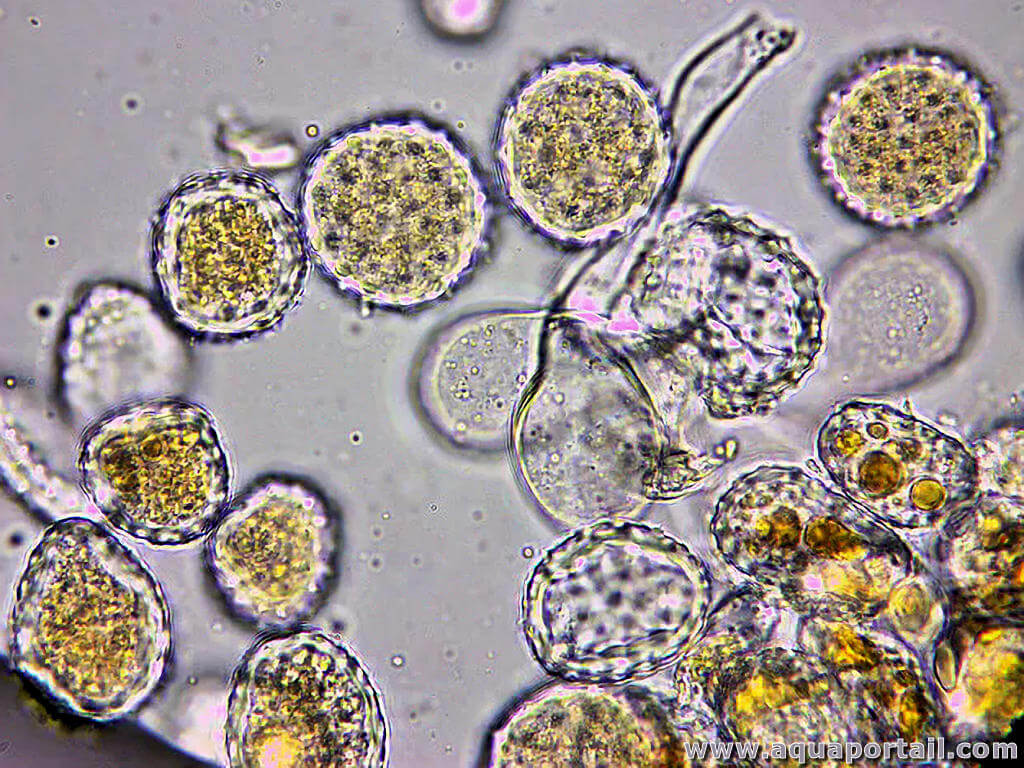
Urediniospores (uredospores) are unicellular, oval-shaped structures. They appear pale brown or rust-red in color.
Explanations
Urediniospores are a type of fungal spore produced by fungi belonging to the Urediniomycetes. They are thin-walled spores most notably observed on leaves. Rust fungi produce urediniospores inside the uredinium or uredosorus (sorus), generally found on the lower surface of the leaf. Urediniospores emerge, exerting pressure on the leaf epidermis and rupturing it.
Urediniospores and teliospores are fungal spores that spread fungal diseases on plants. However, the main difference between a urediniospore and a teliospore lies in the spore cell wall. Urediniospores have thin walls, whereas teliospores have thick walls. Furthermore, urediniospore formation takes place from the uredinium, whereas teliospores form from the telium. This is therefore another difference between the urediniospore and the teliospore. In addition, the color of the two spores also differs: urediniospores are rust-red, whereas teliospores are brown.
Life cycle
Rust fungi have complex and variable life cycles comprising up to five different spore stages (spermatia, aeciospores, urediniospores, teliospores, and basidiospores) produced in structures called sori. This classic life cycle, exemplified by Puccinia graminis, is called macrocyclic and, in some cases, two unrelated hosts may be required for the production of different spore stages, known as heteroecious.
However, the life cycles of rust fungi are plastic, and many species have reduced life cycles lacking one or more of these spore stages.
Moreover, due to the overall complexity of rust life cycles and the fact that spore stages are separated in space and time, the complete life cycles of the majority of described species remain to be elucidated. Traditionally, the spore stages of species were linked through painstaking inoculation experiments. Molecular systematics has simplified linking life-cycle stages using DNA sequences (for example, barcodes).
For example, the aecial and telial stages of wheat yellow rust (Puccinia striiformis) were linked by observing a shared molecular barcode more than a century after the rust was first described.
In heteroecious species, spermogonia and aecia (the sori that produce spermatia and aeciospores, respectively) are produced on a distinct, unrelated host from the one on which uredinia and telia (the sori that produce urediniospores and teliospores, respectively) are formed. The aecial hosts of heteroecious species were thought to be pathways of speciation in rust fungi under an observed phenomenon known as Tranzschel's law, in which a microcyclic species correlates with the aecial host of a macrocyclic heteroecious species.
Rust fungi that complete their life cycle on a single host are called autoecious. Microcyclic rusts (those lacking the uredinial and aecial stages, and in some cases also the spermogonial stage) are all autoecious; macrocyclic rusts (all five stages) and demicyclic rusts (lacking a uredinial stage) can be autoecious or heteroecious. A final variant, termed hemicyclic, is used to describe species for which the spermogonial and aecial stages are unknown.
In true hemicyclic rusts, basidiospores are homothallic and capable of reinfecting uredinial/telial hosts; other species (sometimes erroneously termed hemicyclic) may in fact be heteroecious and macrocyclic rusts with unknown alternate hosts. While the complete life cycles of many rust fungi, including important species such as soybean rust (Phakopsora pachyrhizi), remain unknown, the occurrence of different life-cycle stages is considered homoplastic within the Pucciniales.
Synonyms, antonyms
Spanish translation: uredospora
2 synonyms (similar meaning) for "urediniospore":
2 antonyms (opposite meaning):
Related words and expressions to UREDINIOSPORE are directly connected by general or specific meaning.
The word UREDINIOSPORE is listed on page 1 of words starting with U in the dictionary glossary.
Related to "urediniospore"
teliospore

A teliospore (teleutospore) is a thick-walled, multicellular fungal spore from which the basidium develops.
aplanospore

An aplanospore is a non-swimming spore (as opposed to a planospore or a zoospore). Such spores lack flagella but may possess features of swimming cells such...
archaeospore

In red algae, an archaeospore is the contents of an ordinary vegetative cell which, released without prior mitosis, functions as a spore.
autospore

An autospore is each of the non-motile spores (aplanospores) produced by division and differentiation of the contents of a coccoid unicellular organism.
