Agarose
noun (n.)
Definition
Agarose is a polymer of the agar family with very high gelling power, very low sulfate content, and composed of the regular repetition of a disaccharide unit. This linear polysaccharide formed of alternating D-galactose and L-galactose units is used notably to prepare electrophoresis gels.⭐ Agarose is a polysaccharide formed of alpha- and beta-galactoses, the primary component of agar, extracted from rhodophyte algae of the genera Gelidium and Gracilaria. Agarose is one of the two main components of agar and is obtained by purifying agar from its second component, agaropectin.
Agarose gel:
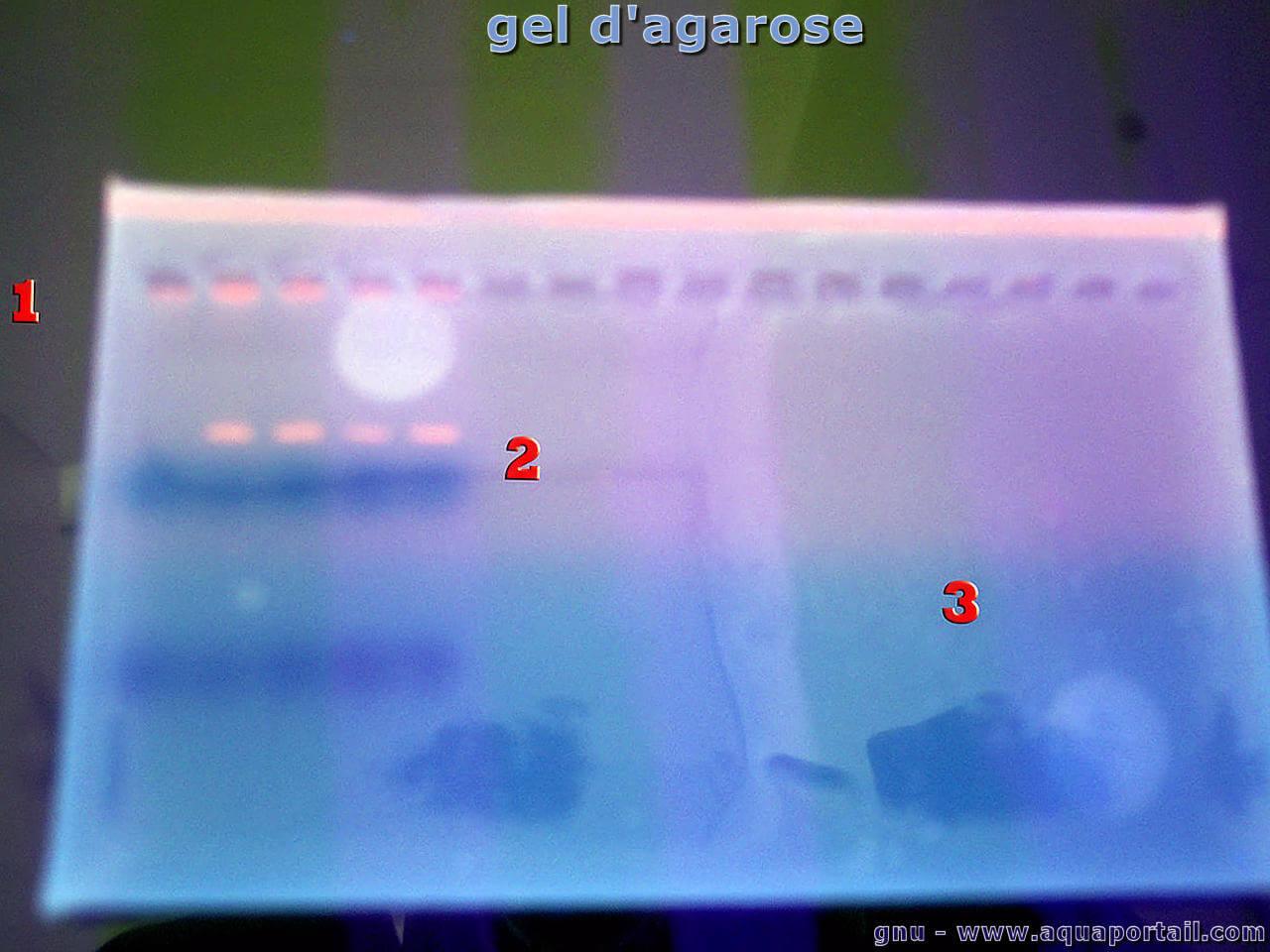
Agarose gel under ultraviolet lamp shows: 1. Loading of DNA solution into wells. 2. DNA samples indicated by the fluorescent ethidium bromide stain after electrophoresis (pale pink bands). 3. Solidified agarose gel polymer.
Explanations
Agarose is soluble in water at temperatures above 65 °C (149 °F), depending on the degree of hydroxyethyl substitution of its side chains. Substitutions can be modified to vary the gelling temperature between 17 and 40 °C (63 and 104 °F). 🚩 Agarose has a melting temperature different from its solidification/gelling temperature, a property defined as thermal hysteresis. Its melting temperature varies depending on the organism from which it is extracted (generally between 80 and 90 °C / 176 and 194 °F), as does its gelling temperature (generally between 30 and 40 °C / 86 and 104 °F), thus exhibiting hysteresis that can vary from 40 °C to over 50 °C (72 to over 90 °F).
✅ Agarose is a linear polymer with a molecular weight of approximately 120,000. The fundamental unit of agarose is agarobiose, a disaccharide consisting of D-galactose and 3,6-anhydro-L-galactopyranose linked by α-(1 → 3) and β-(1 → 4) glycosidic bonds. Each agarose molecule contains about 800 galactose units; the agarose polymer chain forms helical fibers that aggregate into supercoiled structures with a radius of about 20–30 nm. The fibers are semi-rigid, and their length varies greatly depending on agarose concentration.
The three-dimensional structure of agarose is maintained as such by hydrogen bond formation; consequently, upon heating the gel, it reverts to a liquid state.
Agarose is a natural product forming an inert, non-toxic matrix, an indispensable tool in a wide range of molecular biology, biochemistry, and cell biology techniques. Its most widespread use consists of casting gels enabling the separation of DNA molecules by electrophoresis, in addition to being used to immobilize molecules onto its matrix, such as antibodies, antigens, and enzymes. It is also used in cell culture and microbiology. Other less widespread uses include employing these gels as scaffolds for repairing damaged tissues.
✅ Agarose is an excellent matrix for working with proteins and nucleic acids due to its physical and chemical properties as well as its thermal stability. It has a low degree of molecular complexity and is therefore unlikely to interact with other biomolecules.
See also natural polymers.
For RNA separation, special gels containing formaldehyde must be used. Often, visualization aids are already added during gel preparation for detecting separated molecules. In the case of DNA, this is generally ethidium bromide.
Synonyms, antonyms
Spanish translation: agarosa
0 synonyms (similar meaning) for "agarose".
0 antonyms (opposite meaning).
Related words and expressions to AGAROSE are directly connected by general or specific meaning.
The word AGAROSE is listed on page 1 of words starting with A in the dictionary glossary.
Related to "agarose"
agar

Agar is a linear polymer, composed of galactose, extracted from certain phycocolloid red algae (Rhodophyta).
agaropectin
An agaropectin is a molecule of the agar family, very similar in composition to agarose, yet more heavily sulfated and non-gelling.
abiotic

In biology and ecology, abiotic refers to what is not biotic, that is, not part of living beings.
aboral

Aboral refers to what is situated away from or opposite the mouth in zoology, and especially in marine biology.
