Kin selection
noun phrase (n. phr.)
Definition
Kin selection is a theory of natural selection stating that a generally altruistic behavior or trait that decreases the fitness of a particular individual is selected for if it increases the survival and reproductive probability of related kin who possess some or all of the same genes as the altruistic individual.Kin selection:
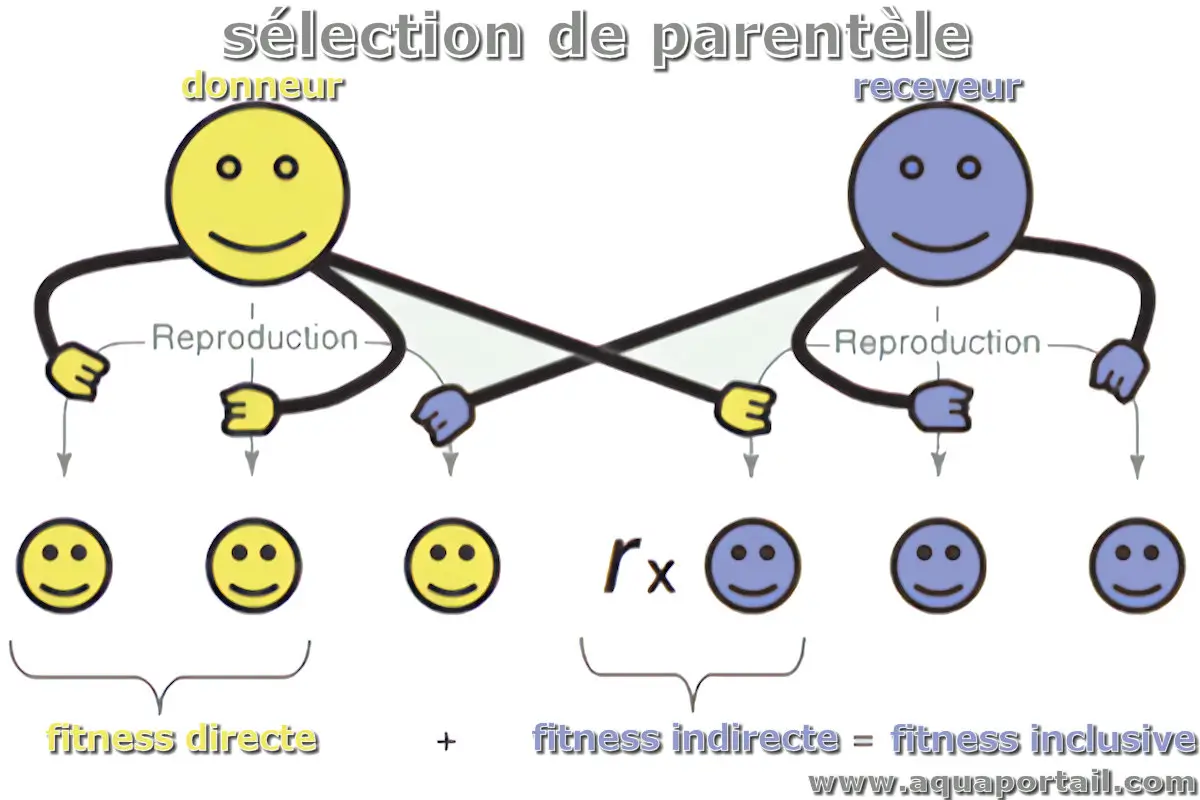
Kin selection is the process by which a trait is favored through an increase in the indirect component of fitness (inclusive fitness).
Explanations
Kin selection is part of natural selection. It generally favors a gene if it increases reproduction, because offspring share copies of that gene. However, a gene may also be favored if it benefits other relatives who also share copies. This selection through kinship is called kin selection.
✅ Kin selection occurs when an animal adopts a sacrificial behavior that benefits the reproductive success (fitness) of its relatives.
The theory of kin selection is due to William Donald Hamilton (1936–2000) in 1964. It is based on the idea that genetic alleles whose effect is disadvantageous to a carrier can be preserved if that carrier acts to increase the survival rate of other carriers of those alleles.
⭐ In the diagram above, a donor carries an allele for a behavioral trait that results in the production of two additional offspring (yellow offspring) and one additional offspring for another individual (blue offspring). Inclusive fitness theory shows that it is necessary to account for both the additional yellow offspring (direct fitness component) and the additional blue offspring (indirect fitness component) to predict the fate of our focal allele. The contribution of the indirect component to fitness depends on the probability that the blue offspring carries the focal allele (relatedness = r).
Theory
Kin selection is best understood from a gene-centered perspective, although it is sometimes compared to group selection models. While it is mathematically possible—and even heuristically valuable at times—to express any fitness change under kin selection as a property of genes or individuals, doing so can obscure the true causal forces driving gene frequency changes under kin selection.
Kin selection is a way of understanding allele frequency changes as a consequence of actions and interactions among individuals sharing alleles through recent common descent, i.e., relatives. As with group selection, it results from group properties that drive allele frequency changes. With kin selection, however, groups possess this specific genetic structure.
Kin selection has been used to explain the evolution of cooperation and altruism in animal societies. The evolution of altruistic traits, selected against within groups yet favored between groups, is facilitated by close relatedness within groups. Within-group fitness losses suffered by altruists are partially offset by the fitness gains of relatives sharing the same genetic information.
In this way, genes controlling behavior can compensate for the fitness losses of donors of altruistic acts. W. D. Hamilton formulated a useful rule for altruistic acts of this kind, determining whether such behaviors are favored by evolution: rb > c. That is, if the benefits (b) conferred on relatives, weighted by the coefficient of relatedness (r) between donor and recipient, exceed the cost (c) incurred by the donor, then such an action is favored by natural selection.
Synonyms, antonyms
Spanish translation: selección de parentesco
2 synonyms (similar meaning) for "kin selection":
- indirect fitness
- kinship selection
0 antonyms (opposite meaning).
Related words and expressions to KIN SELECTION are directly connected by general or specific meaning.
The expression KIN SELECTION is listed on page 1 of words starting with K in the dictionary glossary.
Related to "kin selection"
selection

Selection, in breeding or cultivation, is a selective breeding (or planting) program in which only individuals or families meeting predetermined phenotypic...
contraction

A contraction is the process of becoming smaller. A contraction is the process by which a contractile muscle becomes or is shortened and tightened.
plant reproduction

Plant reproduction is of two types : sexual and asexual. Sexual reproduction is the fusion of male and female gametes within the flower in flowering plants.
reduction
In chemistry, chemical reduction is the opposite of oxidation. During a chemical reduction reaction, a substance gains electrons from another substance called...
