Reverse transcriptase
noun phrase (n. phr.)
Definition
Reverse transcriptase, also called retrotranscriptase and RNA-dependent DNA polymerase, is a DNA polymerase that transcribes single-stranded RNA into DNA. This enzyme is capable of synthesizing double-stranded helical DNA once the RNA has first been reverse-transcribed into single-stranded DNA.Reverse transcriptase:
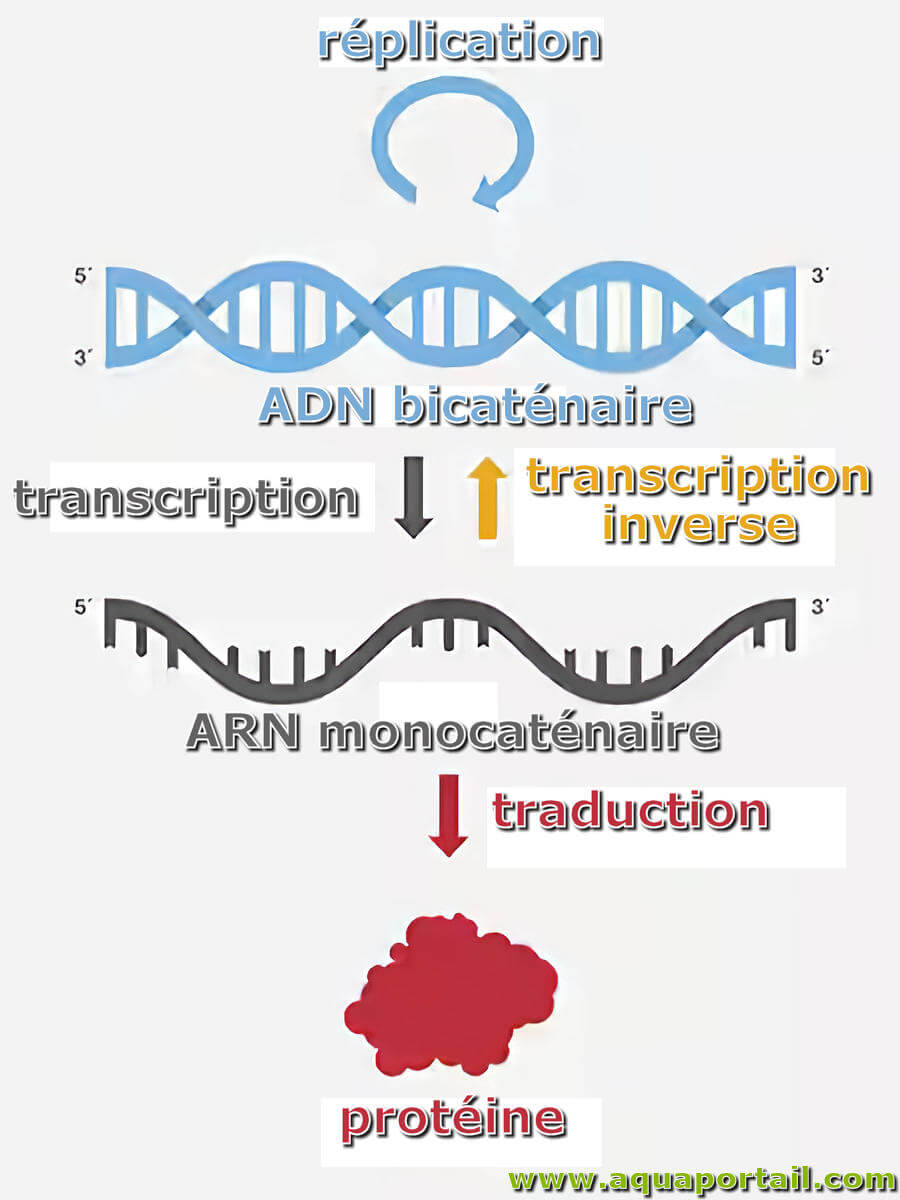
The crystallographic structure of reverse transcriptase reverses (with polymerase and nuclease) and translation yields a new protein.
Explanations
A reverse transcriptase (retrotranscriptase) is an RNA-dependent DNA polymerase; the enzyme synthesizes complementary DNA (cDNA) from an RNA template. The result is a hybrid composed of one RNA strand and one cDNA strand.
Reverse transcriptase is an enzyme produced by certain viruses, retroviruses, and transposable elements of the cellular genome, catalyzing DNA synthesis by copying RNA (the reverse of the usual transcription process in which RNA is synthesized from a DNA sequence). Its transcriptional opposite is transcriptase.
Retrotranscriptase
Retrotranscriptase is a DNA polymerase-type enzyme whose function is to synthesize double-stranded DNA using single-stranded RNA as a template. It catalyzes reverse transcription.
In biology
Its name derives from the fact that the normal transcription process, which may be termed "forward", encodes RNA from the initial DNA sequence, rather than the reverse.
A simple way to synthesize double-stranded DNA using reverse transcriptase, also called DNA/RNA-directed polymerase, is to start from a poly-T-tailed primer that pairs complementary bases with the poly-A tail of the transcribed RNA strand to be synthesized, forming an RNA/DNA hybrid. This hybrid can be separated by ribonucleases, and then, through the action of a DNA polymerase and a new primer, the double-stranded DNA strand is completed.
In molecular biology and biochemistry, reverse transcriptase, also known as RNA-dependent DNA polymerase, is a DNA polymerase enzyme that transcribes a single strand of RNA into a single strand of DNA. It also aids in the formation of a DNA double helix">helix once the RNA has undergone reverse transcription into a single cDNA chain. Reverse transcription involves the synthesis of DNA from RNA.
Reverse transcriptase was discovered by Howard Temin at the University of Wisconsin-Madison and independently by David Baltimore in 1970 at MIT. Both shared the 1975 Nobel Prize in Physiology or medicine with Renato Dulbecco for their discovery. Well-studied reverse transcriptases include:
- human immunodeficiency virus type 1 (HIV-1) reverse transcriptase
- Moloney murine leukemia virus (M-MLV) reverse transcriptase
- avian myeloblastosis virus (AMV) reverse transcriptase
- telomerase reverse transcriptase, which maintains the telomeres of eukaryotic chromosomes.
Origin
The idea of reverse transcription was initially very unpopular because it contradicted the central dogma of molecular biology, which states that DNA is transcribed into RNA, which is translated into proteins. However, in 1970, when scientists Howard Temin and David Baltimore independently discovered the enzyme responsible for reverse transcription, called reverse transcriptase, the possibility that genetic information could be transmitted in this manner was finally accepted.
Function in viruses
The enzyme is encoded and used by viruses in reverse transcription during the replication process. Reverse transcription in RNA viruses, such as retroviruses, uses the enzyme in their genome to transcribe RNA into DNA, which is integrated into the host genome and replicated along with it. Reverse transcription in DNA viruses, such as hepadnaviruses, can allow RNA to serve as a template during assembly, producing DNA strands. HIV infects humans using this enzyme. Without reverse transcriptase, the viral genome could not integrate into the host cell, due to the inability of these viruses to replicate otherwise. Unlike bacteria, retroviruses use host-encoded transfer RNAs as primers.
Reverse transcription process
Reverse transcriptase creates single-stranded DNA from a template RNA.
Viruses lacking reverse transcriptase synthesize their DNA using host cell-encoded DNA polymerase, which mistakenly uses viral RNA as an initiator and synthesizes double-stranded DNA via a primer-removal-like mechanism, where the newly synthesized DNA displaces the original template RNA.
The reverse transcription process is highly error-prone, and it is during this step that mutations can occur. These mutations may lead to drug resistance.
For example, class VI (ssRNA-RT) viruses, also called retroviruses, are reverse-transcribing RNA viruses with a DNA intermediate. Their genome consists of two positive-sense single-stranded RNA molecules with a 5' cap and a 3' polyadenylated tail. Examples of retroviruses include human immunodeficiency virus (HIV) and human T-lymphotropic virus (HTLV). This takes place in the cytosol.
HIV reverse transcriptase also exhibits ribonuclease activity, degrading viral RNA during DNA synthesis, as well as DNA-dependent DNA polymerase activity that copies the sense cDNA strand into antisense DNA to form a double helix of intermediate viral DNA (vDNA).
In eukaryotes
Self-replicating segments of the eukaryotic genome, called retrotransposons, use reverse transcriptase to move from one genomic position to another via an RNA intermediate. They are found abundantly in plant and animal genomes. Telomerase is another reverse transcriptase in eukaryotes, including humans, that carries its own RNA template used for DNA replication.
In prokaryotes
Reverse transcriptase is also found in msr RNAs of retron bacteria, distinct sequences encoding reverse transcriptase involved in the synthesis of multicopy single-stranded DNA (msDNA). To initiate DNA synthesis, a primer is required. In bacteria, the primer is synthesized during replication.
Structure
Reverse transcriptases comprise an RNA-dependent DNA polymerase and a DNA-dependent DNA polymerase, which work together to carry out transcription. In addition to the transcription function, retroviral reverse transcriptases possess a domain belonging to the RNase H family, which is vital for their replication.
Replication fidelity
There are three distinct replication systems during the life cycle of a retrovirus. First, reverse transcriptase synthesizes viral DNA from the viral RNA and then from the newly created complementary DNA strand. The second cellular replication process occurs when host cell DNA polymerase replicates the integrated viral DNA. Finally, RNA polymerase II transcribes the proviral DNA into RNA, which is packaged into virions. Consequently, mutations can arise during any or all of these replication steps.
Reverse transcriptase exhibits a high error rate when transcribing RNA into DNA because, unlike DNA polymerases, it lacks proofreading capability. This high error rate allows mutations to accumulate at an accelerated pace compared to high-fidelity replication forms. Commercially available reverse transcriptase has an error rate ranging from 1 in 17,000 bases for AMV to 1 in 30,000 bases for M-MLV.
Applications
Applications include antiviral drugs. Since HIV uses reverse transcriptase to copy its genetic material and generate new viruses (part of a retroviral proliferation cycle), specific drugs have been designed to halt the process and thus prevent its spread.
Collectively, these drugs are known as reverse transcriptase inhibitors and include nucleoside and nucleotide analogs such as zidovudine (brand name Retrovir), lamivudine (Epivir), and tenofovir (Viread), as well as non-nucleoside inhibitors such as nevirapine (Viramune).
In molecular biology, reverse transcriptase is commonly used in research to perform reverse transcription polymerase chain reaction (RT-PCR). Conventional PCR can only be applied to DNA strands, but with the aid of reverse transcriptase, RNA can be transcribed into DNA, enabling PCR analysis of RNA molecules.
Reverse transcriptase is also used to create cDNA libraries from mRNA. The commercial availability of reverse transcriptase has greatly advanced molecular biology knowledge because, in combination with other enzymes, it has enabled scientists to clone and characterize DNA sequences.
Synonyms, antonyms
Spanish translation: transcriptasa inversa
2 synonyms (similar meaning) for "reverse transcriptase":
- retrotranscriptase
- RNA-dependent DNA polymerase
1 antonym (opposite meaning):
Related words and expressions to REVERSE TRANSCRIPTASE are directly connected by general or specific meaning.
The expression REVERSE TRANSCRIPTASE is listed on page 1 of words starting with R in the dictionary glossary.
Related to "reverse transcriptase"
transcriptase
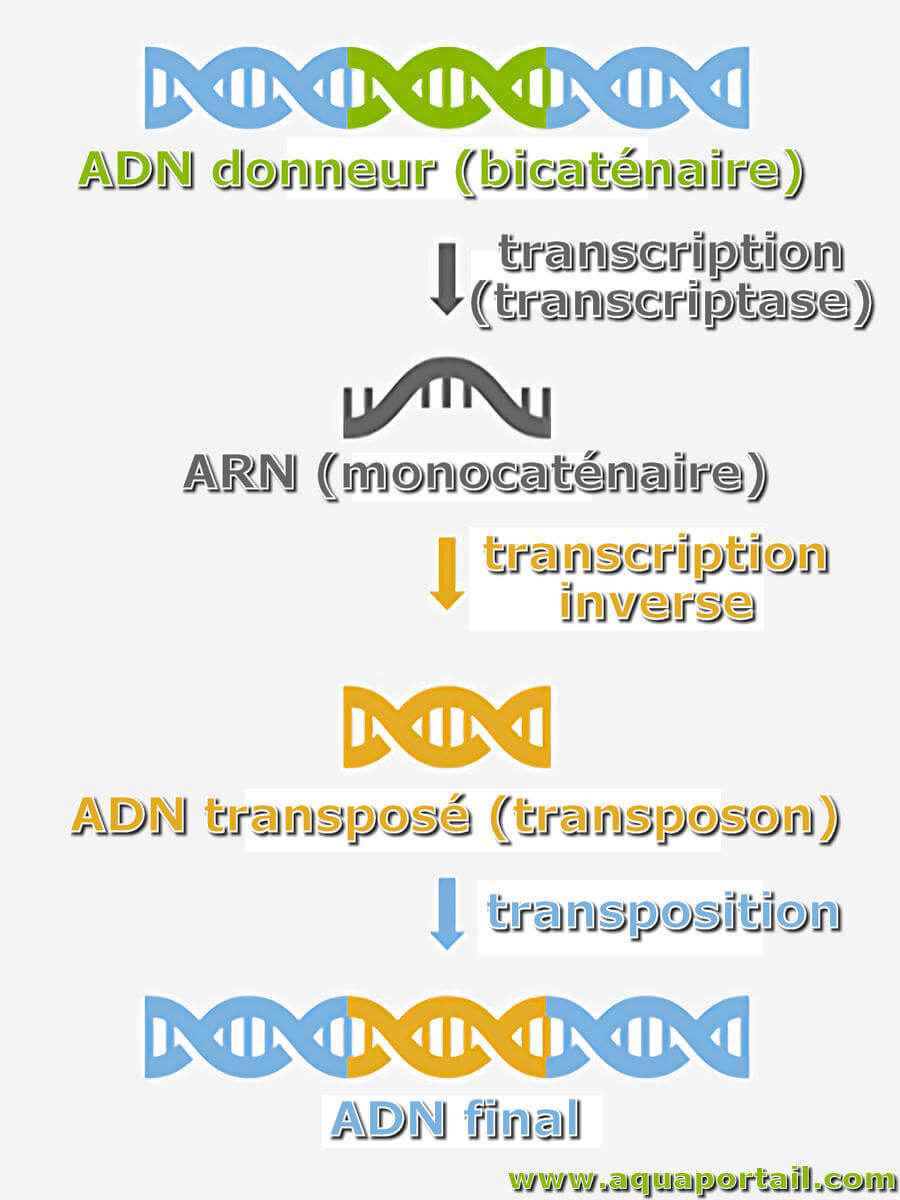
Transcriptase activity within an assembled virion catalyzes the synthesis of progeny positive-strand RNA from the parental double-stranded RNA (dsRNA)...
ramulus

A ramulus is a small branching of branches or stems of a plant that has undergone a metamorphosis resulting in growth arrest.
rat

A rat is a rodent mammal resembling a large mouse, generally having a pointed snout and a long, sparsely haired tail.
reaction rate

The chemical reaction rate corresponds to the change in concentration of a reactant (taken as a positive value) or a product over time, divided...
