Plate tectonics
noun phrase (n. phr.)
Definition
Plate tectonics is a theory that explains continental drift, earthquakes, deep ocean trenches, and other phenomena through the movement of the vast rigid plates that make up Earth's surface. It studies tectonic plates.Rock formation can be conceptualized as a highly dynamic system called the rock cycle. The rock cycle is driven by the plate tectonic cycle.
Diagram of plate tectonics:
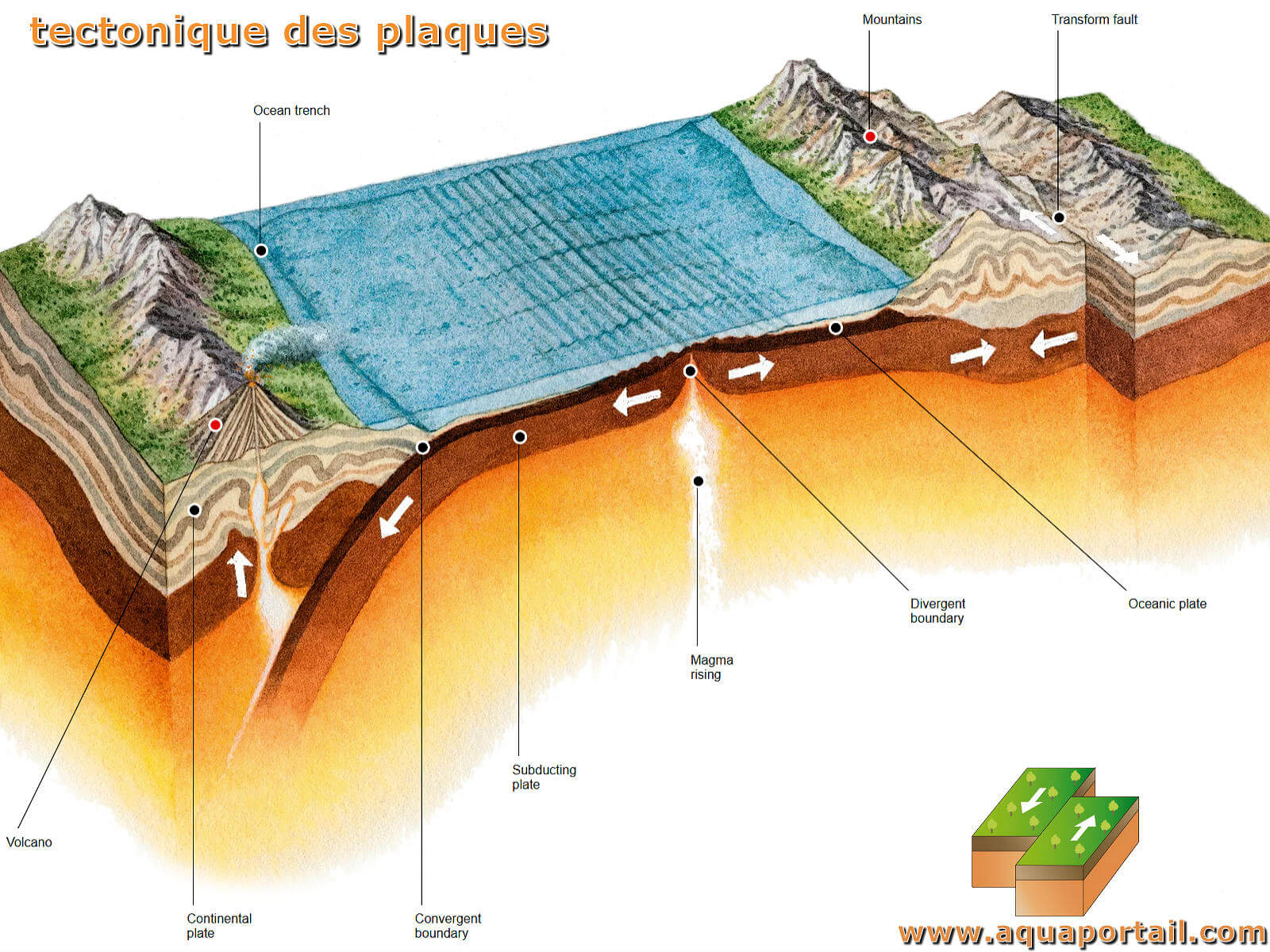
Plates on Earth's surface move due to the intense heat of the planet's core. This phenomenon is called plate tectonics.
Explanations
Plate tectonics is a branch of Earth Sciences that studies the movements of lithospheric plates, their role in the genesis of mountain ranges, and the various zones of the world where they are active. It was discovered by the famous German scientist Wegener, who was the first to conceive continental drift from observing the similarity in coastline contours between West Africa and Brazil. The seven major continental plates and five major oceanic plates are not fixed, but move relative to one another.
The hypothesis, solidly substantiated today, establishes that the outermost part of the Earth - the lithosphere - is divided into rigid plates about a hundred kilometers thick (about 70 km / 43.5 mi beneath oceans, about 150 km / 93 mi beneath continents) resting on a viscous medium - the asthenosphere - capable of flowing. These plates move relative to one another.
The driving force behind these spectacular yet very slow movements (measured in cm per year) lies in the large convection currents churning Earth's mantle, originating from the enormous temperature differences between the core (4,000 °C / 7,232 °F at the core-mantle boundary) and the base of the lithosphere (1,300 °C / 2,372 °F).
The upwelling limb of these convection currents brings up deep, hot mantle materials, resulting at the surface in plate divergence, the formation of oceans from mid-ocean ridges, and the continuous creation (seafloor spreading), via basaltic volcanism developing along these ridges, of new portions of oceanic crust (accretion).
The downwelling limb of convection currents leads to plate convergence and draws oceanic lithosphere toward continents (west coast of South America, east coast of the Asian continent, for example). This occurs along an oblique plane plunging beneath the continent: the Wadati-Benioff zone. This sinking of oceanic lithosphere into the subcontinental mantle is called subduction.
Associated with this subduction, all along the collision zone, are very deep oceanic trenches (the Mariana Trench, for example, reaches 11,000 m / 36,089 ft depth), intense volcanic activity (emitted lavas are andesitic in nature) and seismic activity, as well as uplift of the continental margin forming a mountain range (the Andes Cordillera, among others). The closure of ancient oceans, through subduction of the entire oceanic portion of a plate, is responsible for the collision of certain continents and the formation of Alpine-type mountain belts (collision between the Indian continent and the Asian continent).
The tectonic plate
A tectonic plate is a large, irregularly shaped slab of solid rock composed of oceanic and continental lithosphere. Plate size varies widely, ranging from a few hundred to thousands of kilometers. Plates on Earth's surface move due to the intense heat of the planet's core. The heat causes molten rock to move in a pattern of convection cells, thereby causing the plates to shift.
Theory
The mechanism of tectonic plate movement has been a subject of debate among Earth scientists. They once based their argument on convection cells upon which Earth's tectonic plates rode. However, they currently believe that tectonic plate movement depends not only on mantle convection cells, but also on plate motion matching the convection cells. Plate tectonic theory is based on the fact that hotter, thinner parts of tectonic plates have a strong tendency to rise, while colder, denser parts have a strong tendency to sink.
New parts of plates constitute the hot, thin portions, whereas older parts constitute the cold, dense portion. Through ridge push, hot magma rises and forms crust at the surface, pushing the other part of the plates outward. Conversely, older sections sink into the mantle at subduction zones through the slab pull process, as they are denser than mantle material. Plate tectonic theory develops from ridge push and slab pull, which together drive tectonic plate motion.
Controversy
Based on mantle convection cells and plate tectonic theory, the workings of plate motion seem to lack further detail to explain it fully. Earth scientists still debate among themselves the exact mechanism by which Earth's tectonic plates move. Consequently, the detailed process of motion remains highly debated.
Synonyms, antonyms
Spanish translation: tectónica de placas
1 synonym (similar meaning) for "plate tectonics":
0 antonyms (opposite meaning).
Related words and expressions to PLATE TECTONICS are directly connected by general or specific meaning.
The expression PLATE TECTONICS is listed on page 1 of words starting with P in the dictionary glossary.
Related to "plate tectonics"
tectonics

Tectonics is a branch of geology that studies the structure of the crust of a planetary body, such as Earth or the Moon, particularly the formation of folds...
hydroponics

Hydroponics is a method of soilless plant cultivation, and hydroponic farming is a subset of hydroculture.
paedomorphosis

Paedomorphosis (juvenilization) is a phylogenetic change involving the retention of juvenile or even larval traits into a later (adult) stage.
pandemic

A pandemic is the widespread outbreak of an epidemic infectious disease across a vast geographic area at a given time.
Simple summary
Plate tectonics is the scientific theory explaining the movement and interaction of Earth's lithosphere, which is divided into several plates of varying sizes. These plates float on the semi-fluid asthenosphere beneath them within Earth's mantle. This theory accounts for various geophysical phenomena, such as earthquakes, volcanic activity, mountain building, and ocean trench formation, all resulting from interactions at the boundaries of these tectonic plates.
