Daphnia
noun (n.)
Definition
Daphnia is a planktonic branchiopod crustacean of the family Daphniidae, forming a dominant portion of freshwater plankton. Depending on the species, daphnia measure 1 to 5 millimeters (0.04 to 0.2 in) in length: these invertebrates belong to the mesoplankton. Daphnia are used to feed freshwater aquarium fish.Daphnia compared and explained across several diagrams :
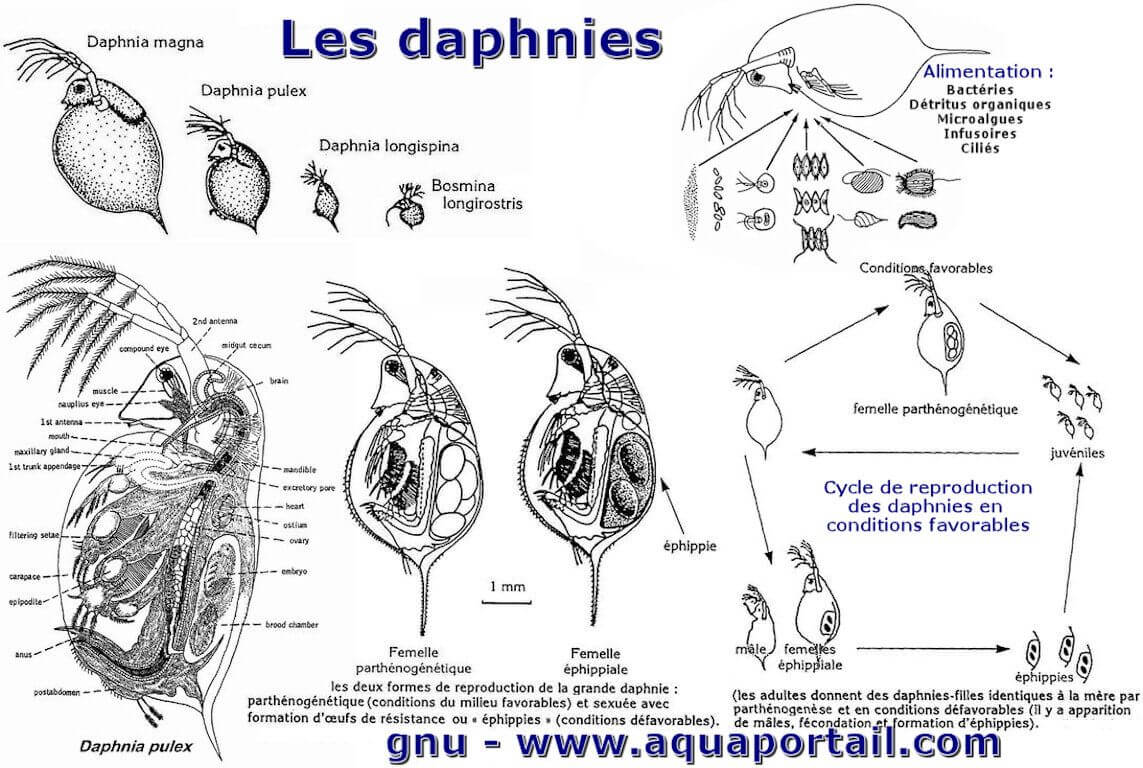
Different species of daphnia are accompanied by diagrams illustrating various cladoceran cycles, including feeding and the parthenogenetic reproductive cycle of daphnia.
Explanations
The common name daphnia comes from its nomenclatural genus Daphnia sp.; they are also called "water fleas". Daphnia are used to conduct freshwater ecotoxicity tests (standardized tests on the species Daphnia magna or Daphnia pulex).
A daphnia:

Daphnia belongs to the macroplankton because it is a small freshwater planktonic crustacean visible to the naked eye.
Daphnia inhabit diverse aquatic environments ranging from acidic bogs to the freshwater of lakes, ponds, streams, and rivers. These phyllopod cladoceran crustaceans are sometimes called "water fleas" because their swimming style resembles the movements of fleas.
In aquaristics, live daphnia serve as live food for aquarium fish or fry, and red daphnia help enhance fish coloration.
Anatomy of a daphnia
Close-up of Daphnia pulex:

Anatomical close-up of a daphnia of the species Daphnia pulex.
The micro-crustacean genus Daphnia, living primarily in freshwater, measures 0.5 to 5 mm (0.02 to 0.2 in) in length; the body is divided into segments, although this segmentation is not externally visible. The head is fused with the body and bends downward with a visible notch separating the two. In most species, the rest of the body is covered by a carapace, with a ventral gap into which five or six pairs of legs are inserted. The most prominent features are the compound eyes, second antennae, and a pair of abdominal setae. In many species, the carapace is translucent or nearly so, making daphnia excellent subjects for microscopic observation where the beating heart can be seen.
Comparison with other micro-crustaceans
Daphnia (left) and cyclops (right) coexist:
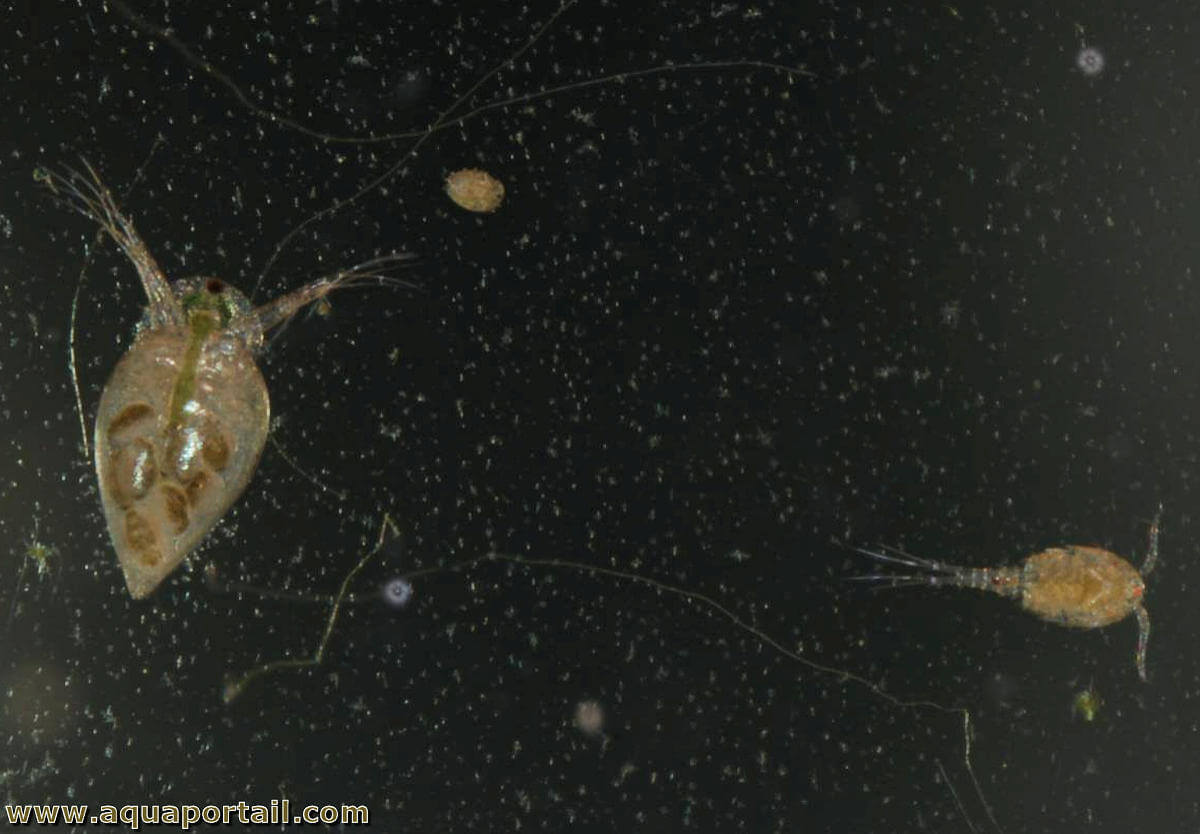
Daphnia and cyclops coexist in the same freshwater ecosystems without competing with each other.
Daphnia are a frequently used food source in freshwater larviculture (for example, for cyprinids) and ornamental fish production. The two most readily available species of Daphnia are Daphnia pulex (small and most common) and Daphnia magna (large daphnia). Both species are often associated with a related genus in the order Cladocera. The genus Moina in the family Moinidae rather than Daphniidae, including Moina macrocopa, is much smaller than D. pulex (about half the maximum length). The same holds true for cyclops, which are even smaller.
Daphnia are smaller than brine shrimp and better suited for feeding small fish (micro-fish). They survive much longer in freshwater than brine shrimp, which normally live in saltwater.
Eggs and reproduction
Photograph of a group of Daphnia magna in a glass:
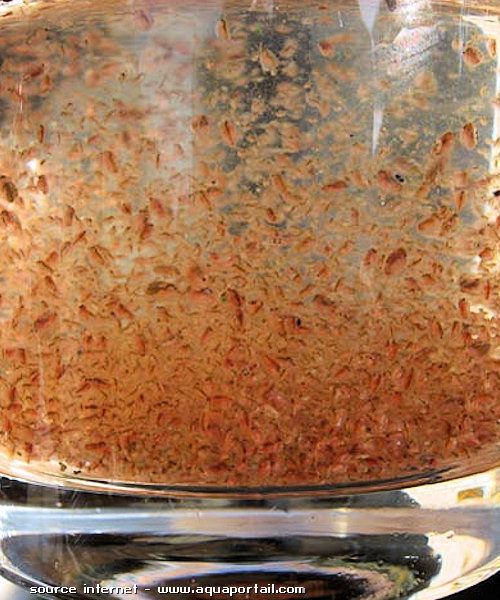
Daphnia culture begins in a small volume of freshwater, such as a recycled mineral water bottle, into which a few dozen adult daphnia are placed. The water volume is gradually increased to maintain clean water alongside a substantial animal density.
To harvest daphnia, use a micron bag—it is very practical. See the article: breeding daphnia: supplying live daphnia for fish spawns! Daphnia undergo cyclomorphosis.
Commercially sold eggs of the genus Daphnia are generally enclosed within their ephippia, a thick shell composed of two chitinous valves that surrounds and protects a cladoceran's overwintering eggs.
Synonyms, antonyms
Spanish translation: dafnia
0 synonyms (similar meaning) for "daphnia".
0 antonyms (opposite meaning).
Related words and expressions to DAPHNIA are directly connected by general or specific meaning.
The word DAPHNIA is listed on page 1 of words starting with D in the dictionary glossary.
Related to "daphnia"
brine shrimp

Brine shrimp are small primitive crustaceans measuring about 1 cm (0. 4 in) that inhabit salt marshes and salt pans, ranging from brackish to hypersaline...
dale

A dale is a small valley or glen that does not (or no longer) contains a watercourse. The concave hollowed space of a dale is not large enough to build...
dawn

Dawn marks the transition between night and day, when the sky brightens and morning breaks in the East.
deltoid
Generally, what is deltoid is triangular, having a shape that evokes the uppercase Greek letter delta Δ, delta-shaped.
