Peanut
noun (n.)
Definition
A peanut is the legume Arachis hypogaea that produces underground pods (fruits) whose seeds are called peanuts (or groundnuts). The peanut is a species in the family Fabaceae.
The peanut Arachis hypogaea and its pods:
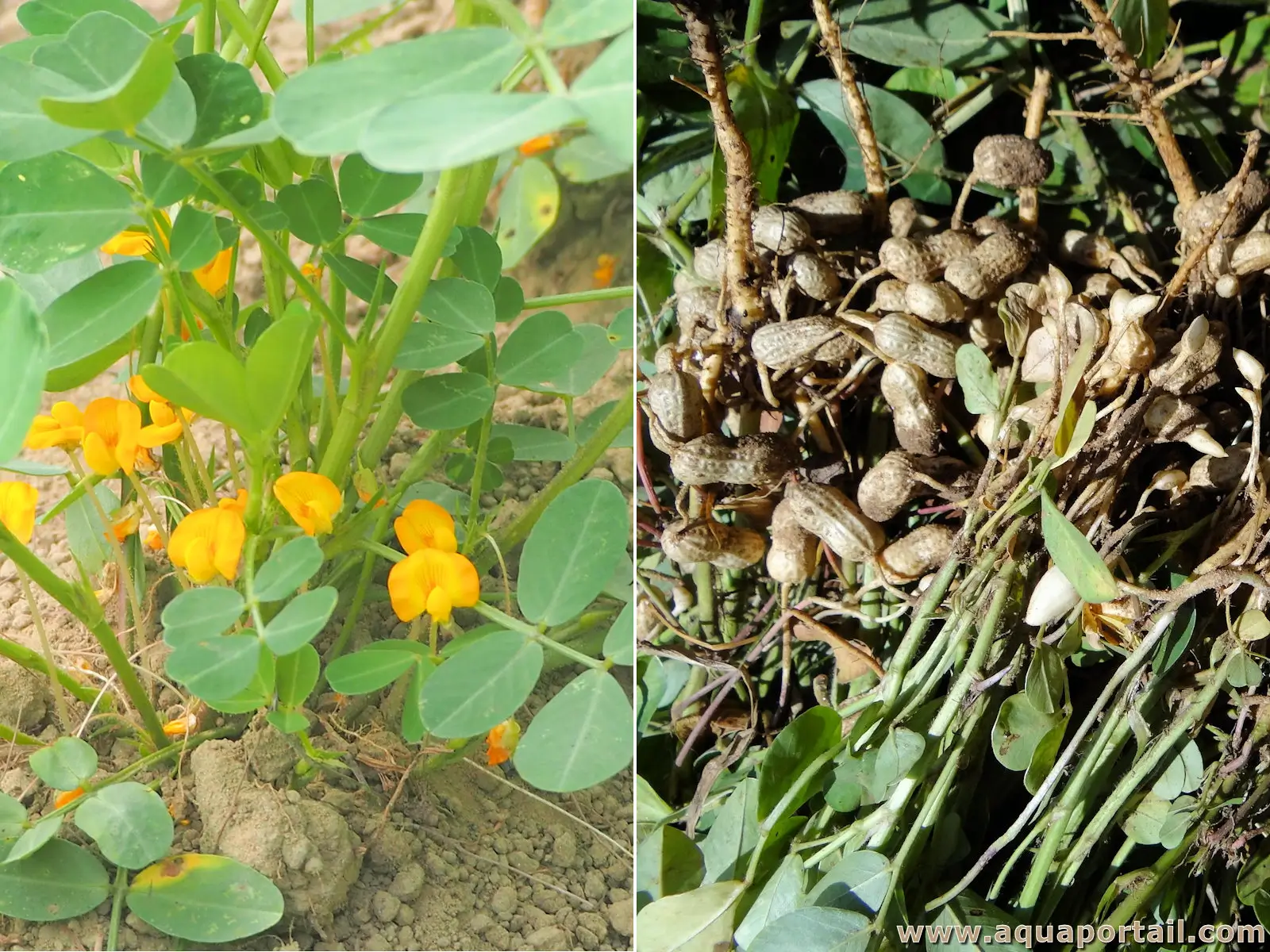
Arachis hypogaea is the scientific name of the peanut. Peanut fruits grow underground inside a two-valved pod that protects the seeds (peanuts).
Explanations
The peanut Arachis hypogaea is a tropical to subtropical leguminous plant resembling peas (order Fabales). It is cultivated for its underground pods to produce peanuts and to extract oilseed products for peanut oil.
The notable characteristic of the peanut is the hypogeal, underground growth of its fruits (in Latin, "hypogaea" means "under the earth"). The plant must be uprooted near maturity to harvest the pods.
As a reminder, peanuts are the seeds contained inside the peanut pod.
Peanut seeds are edible and rich in proteins, minerals, and vitamins. The roots, shells, or leaves are used in the manufacture of cosmetics, soaps, plastics, wallboards, livestock feed, fertilizers, and alternative fuels.
The term arachidic refers to various compounds or substances derived from or related to arachidic acid (a saturated fatty acid commonly found in peanut oil and other vegetable oils). It may apply to chemical compounds or materials containing arachidic acid or related products in fields such as nutrition, chemistry, and food science.
Arachis hypogaea
Arachis hypogaea, or peanut, is a legume native to central Brazil and now widely cultivated worldwide, primarily for its edible seeds. The species name hypogaea means "under the earth" and reflects the fact that the pods containing the edible seeds grow underground. The peanut is a perennial herbaceous plant, though cultivated as an annual. It produces aerial flowers, but develops its fruits underground through a process called geocarpy (geocarpic fruits).
The peanut Arachis hypogaea:
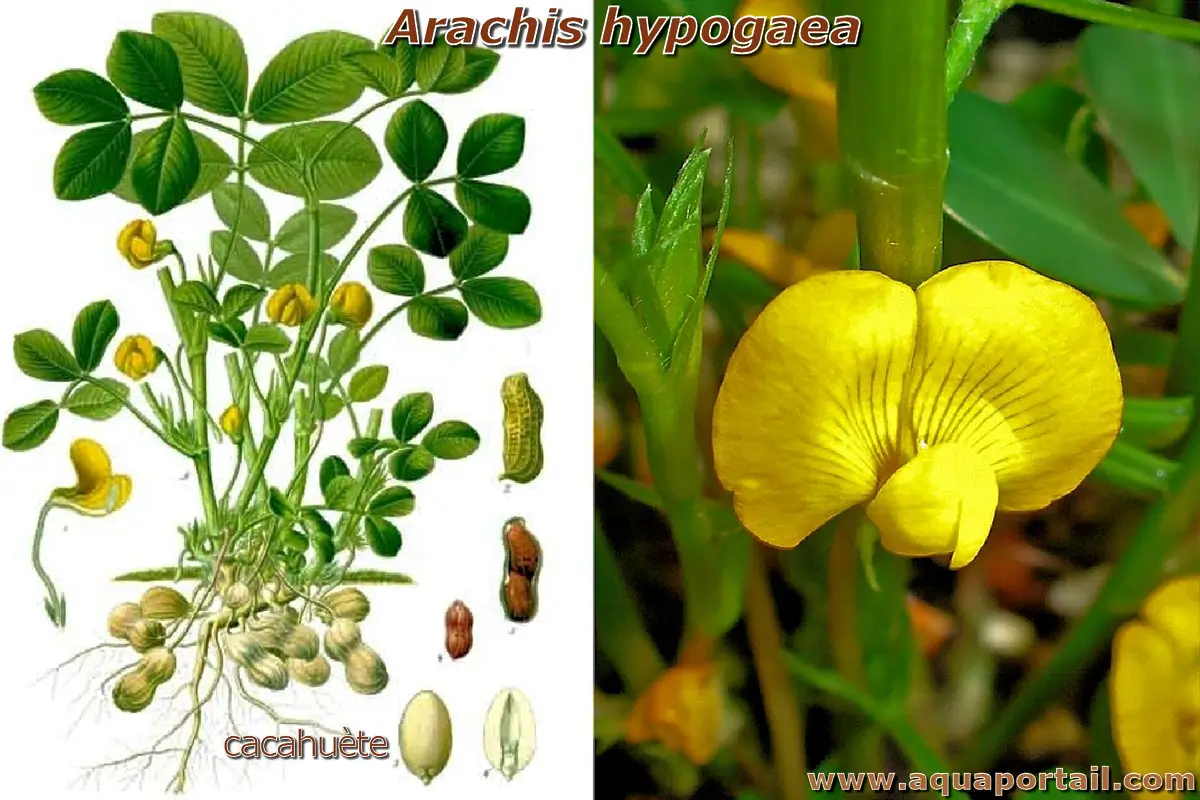
Descriptive plate of Arachis hypogaea, the peanut, with detail of the yellow flower.
Like most legumes, the peanut possesses roots containing nodules of nitrogen-fixing bacteria, making it a valuable plant for soil enrichment. When removing plant remains at the end of the growing season, remove only the aerial parts of the plant and leave the roots in the ground to decompose and release their nitrogen.
The peanut thrives in warm climates, in full sun, and in loamy, light, sandy, well-drained soil. It is not frost-hardy and is preferably grown in regions with long, warm summers. Sow the seeds in spring, once the soil has warmed, in well-composted, fertile, light, sandy, well-drained soil in full sun. Plant the seeds (peanuts) about 5 cm (2 in) deep, in rows spaced about 90 cm (35 in) apart, with 15 to 23 cm (6 to 9 in) spacing. After the first autumn frosts, dig up the plants, shake them off, and spread them on a dry surface, off the ground, to let them dry before extracting the pods. The pods generally mature 120 to 150 days after sowing.
Most varieties can be upright or spreading, with a growth cycle of 4 to 5 months depending on the variety. The attractive, low-growing, pea-like yellow flowers self-pollinate and then produce a "peg" (gynophore) that grows downward and away from the plant to penetrate the soil, from which the peanut pod will develop.
Four main peanut varieties are cultivated:
- the Runner peanut, the most widespread, is often used in peanut butter production
- Virginia peanuts (in the United States) have the largest kernels and are often processed in-shell and used as gourmet peanuts. North Carolina is a major producer of Virginia peanuts
- Spanish peanuts have smaller kernels covered with a reddish-brown skin and are often used in confections. Their oil content is higher than that of other varieties
- Valencia peanuts have three or more seeds per pod and are covered with a bright red skin. They are very sweet peanuts, prized roasted or boiled.
Synonyms, antonyms
Spanish translation: cacahuete
0 synonyms (similar meaning) for "peanut".
0 antonyms (opposite meaning).
Related words and expressions to PEANUT are directly connected by general or specific meaning.
The word PEANUT is listed on page 1 of words starting with P in the dictionary glossary.
Related to "peanut"
paedomorphosis

Paedomorphosis (juvenilization) is a phylogenetic change involving the retention of juvenile or even larval traits into a later (adult) stage.
pandemic

A pandemic is the widespread outbreak of an epidemic infectious disease across a vast geographic area at a given time.
parchment

Historically, true parchment is animal skin prepared (limed, dried, thinned, dressed) to write or print upon.
pasture

Pasture is agricultural land covered with grasses and herbaceous vegetation on which livestock graze.
Simple summary
Arachis hypogaea is the scientific name of the plant commonly called the peanut (or groundnut). This legume is native to South America and widely cultivated for its edible seeds, commonly used in cooking, eaten as snacks, or processed into products such as peanut butter and oil. Peanuts grow underground, an unusual trait among nuts and seeds, as the plant develops its pods in the soil. They are valued for their high protein content and nutritional qualities.
