Gelation
noun (n.)
Definition
In chemistry, gelation is a process leading to the formation of a gel during the transition from a fluid or liquid state to a nearly solid state called the gel state. Solidification occurs upon cooling, or it can be induced by adding gelling agents that increase viscosity.
Gelation of macromolecules:
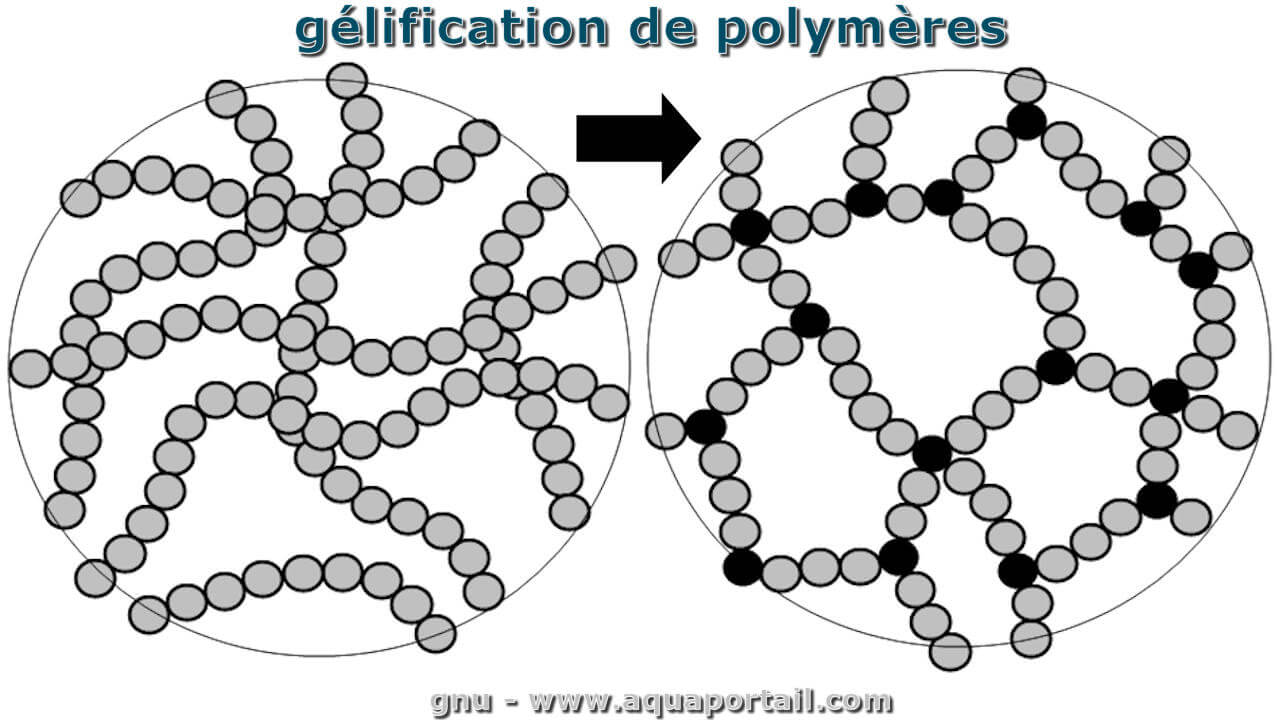
On the right, a polymer (of macromolecules) has undergone gelation, compared to the ungelled polymer on the left.
Explanations
Gelation describes the process of gel formation. Isolated building blocks are initially cross-linked to form a viscoelastic network, the gel. The constituent elements may be suspended colloidal aggregates (sol), which then serve as gelling agents.
In the sciences
In the life and earth sciences, definitions of gelation vary and differ slightly from the strictly physical phenomenon.
In botany, at the cellular level, gelation is a modification of the plant cell wall, which becomes soluble, strongly hygrophilic, and swells while turning fluid. This transition to a gel state triggers, in some cases, hypersecretion of pectic compounds leading to the formation of mucilages or gums. Gums and mucilages are gelled forms sometimes grouped under the term mucigel.
In polymer chemistry and biology, gelation is the sudden bulk solidification of a reaction medium during the polycondensation of a monomer mixture possessing more than two reactive functional groups.
✅ Theories describing gel formation include Flory-Stockmayer theory and the Erdős-Rényi model, in which a gel is understood as a "random graph".
Certain thickening agents act as gelling agents, forming a gel by dispersing in the liquid phase as a colloidal mixture that builds a weakly cohesive internal structure.
Applications of gelation
Sol-gel chemistry finds applications in nanotechnology for manufacturing ceramics and ceramic fibers.
Gelation plays a role in food preparation, for example in the production of jellies.
In plastics technology, the entire curing process of a reactive mixture is often termed gelation when it proceeds through an intermediate gel-like state (for example in polyurethanes, epoxies, and polyester resins). The manufacture of flexible PVC also relies on gelation, in which plasticizers and PVC powder are transformed into a homogeneous mass from which finished products can subsequently be shaped.
Gel point
The exact moment at which the transition to a gel occurs is called the gel point or gelation point. However, several definitions exist for it.
With increasing cross-linking of particles during gelation or the sol-gel process, the gel point is generally defined by the linking of aggregates to form a single macroscopic network, creating a continuous span at the expense of the sol.
An alternative rheological definition defines the gel point as the point at which the storage modulus and loss modulus become equal in magnitude. A simple practical definition defines the gel point as the moment when a sample no longer deforms or flows under gravity.
A definition based on the abrupt rise in viscosity is also possible, though this can only be viewed approximately since the gelation process often spans extended periods of time.
Synonyms, antonyms
Spanish translation: gelificación
2 synonyms (similar meaning) for "gelation":
0 antonyms (opposite meaning).
Related words and expressions to GELATION are directly connected by general or specific meaning.
The word GELATION is listed on page 1 of words starting with G in the dictionary glossary.
Related to "gelation"
bacterial flagellum

A bacterial flagellum is a prokaryotic flagellum found in bacteria or monerans. It is essential for motility, adhesion, and colonization, and forms part...
biflagellate

In zoology, biflagellate describes what possesses two flagella, referring to a doubly flagellated cell or microorganism equipped with two flagella.
eukaryotic flagellum

A eukaryotic flagellum (vs. prokaryotic) is a flexible, whip-like cellular organelle composed of an axoneme and a kinetosome, used for locomotion in motile...
flagellate

Flagellates, or mastigophorans, are a heterogeneous group of protozoans characterized by the presence of one or more long flagella during one or all stages...
