Small dike
noun phrase (n. phr.)
Definition
A small dike refers to a low embankment, wider than a ridge, typically with a minimum height of 20 cm (8 in) and a maximum height of one meter (3.3 ft). Small dikes are essential in wetland cultivation, used to control runoff water in an irrigated area, particularly in rice paddies.
Small dikes in a rice paddy:
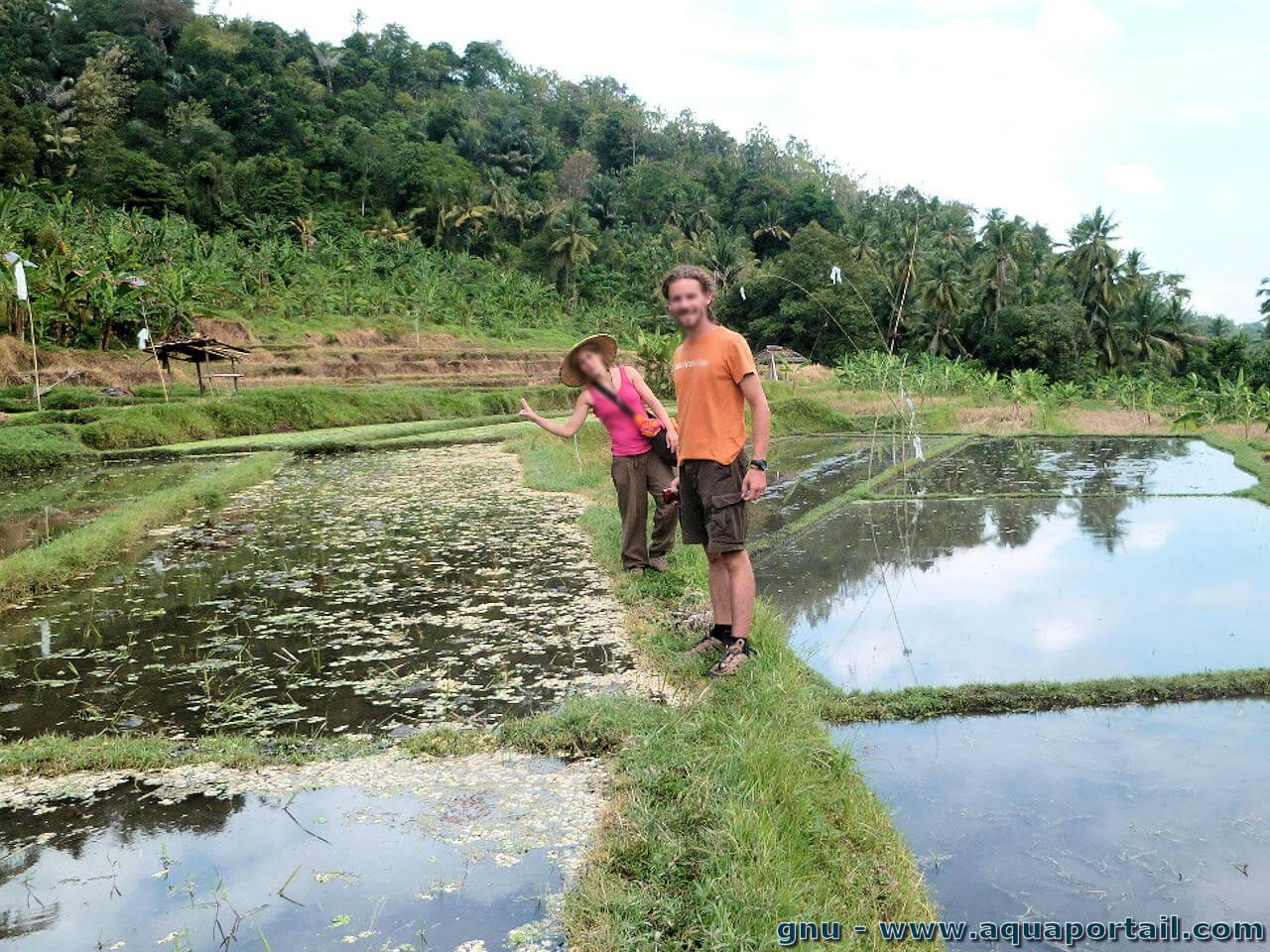
A small dike is a regulating structure used to retain water from small streams or a river branch. Small dikes are useful in rice cultivation to keep irrigation water inside cultivated plots.
Explanations
Small dikes are characterized by their construction material (earthen bund, stone bund, or composite bund), their shape (triangular, trapezoidal, or semicircular), their size (large semicircular bund), their position relative to the ground slope (contour bund, graded diversion bund, perpendicular diversion bund), and sometimes by the presence of transverse bunds (tie bund).
Small dikes for salt harvesting:

Salt marsh bunds play a vital role in separating water retention basins from any new inflow of seawater. This technique allows evaporation and salt harvesting.
A small dike is a low wall or earthen structure serving as an embankment, boundary, or defense. Equipping land with a small dike prevents and stops minor flooding. For example, bunds enclose marshes along rivers to create summer pastures.
Temporary bunds can be built with sandbags to prevent a small stream from overflowing.
✅ In geology, a dike is an intrusion of igneous rock cutting across existing strata, forming a large rock slab that crosses a watercourse.
Synonyms, antonyms
Spanish translation: pequeño dique
6 synonyms (similar meaning) for "small dike":
- cofferdam
- dam
- dike
- impoundment
- jetty
- levee
0 antonyms (opposite meaning).
Related words and expressions to SMALL DIKE are directly connected by general or specific meaning.
The expression SMALL DIKE is listed on page 1 of words starting with S in the dictionary glossary.
Related to "small dike"
reservoir

A reservoir is, first and foremost, a natural or artificial site used for the storage, regulation, and control of water resources.
saccharide

A saccharide is a carbohydrate, a biomolecule composed of carbon, hydrogen, and oxygen atoms, usually with a hydrogen-to-oxygen atomic ratio of 2 :1.
saccule

A saccule is a flattened cellular cavity shaped like a small concave disk and bounded by a membrane, a stack of which forms a dictyosome.
sagittocyst

A sagittocyst is a capsule containing a spindle-shaped needle produced by epidermal cells of certain flatworms (acoels).
