Forestry
noun (n.)
Definition
Forestry is the professional activity of cultivating, conserving, planting, creating, and managing forests through the landscape management of trees. Forestry or silviculture is a form of forest management with economic benefits in which forests serve at least partly as a natural resource.A birch forest managed in forestry:
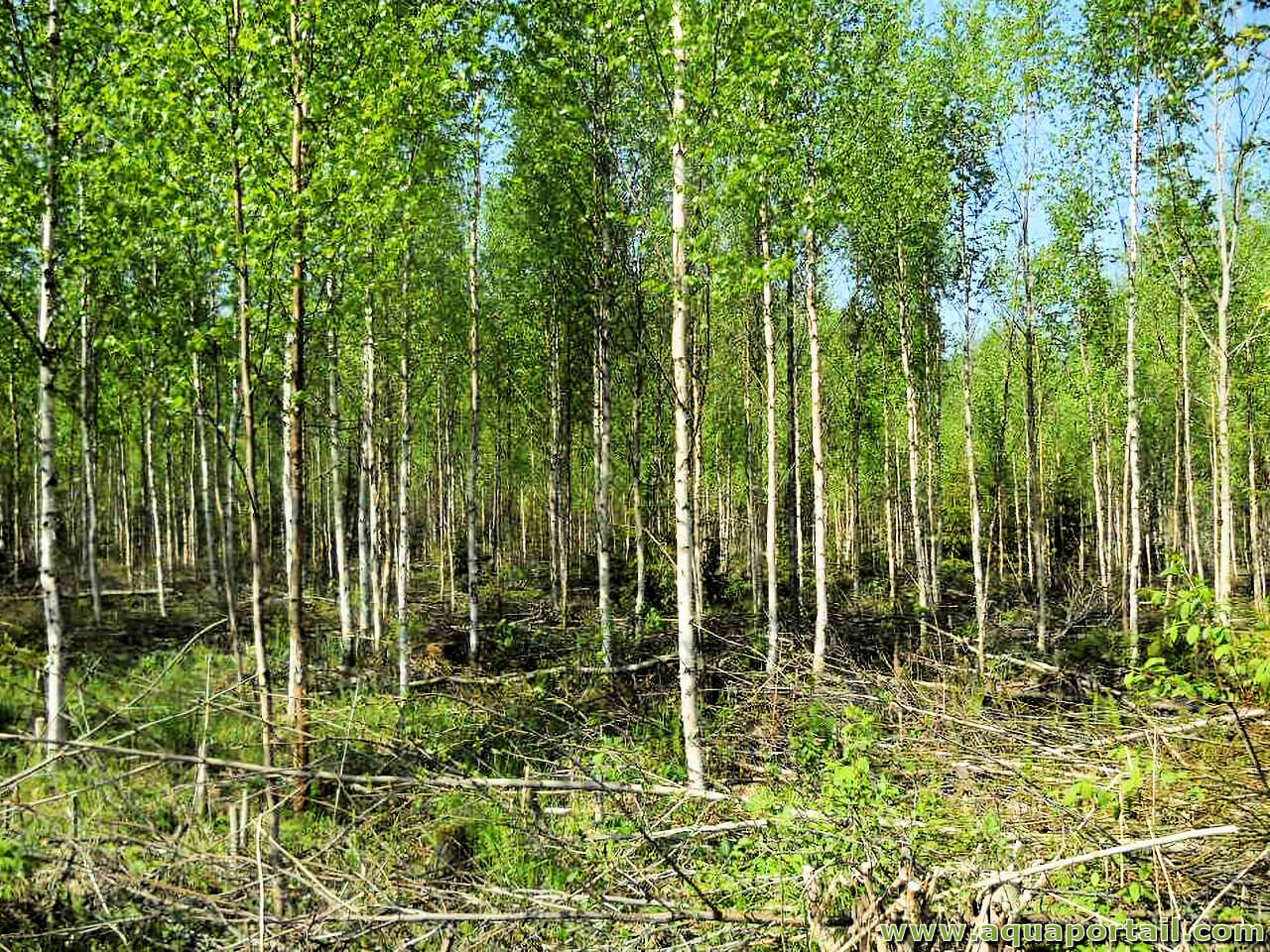
Forestry is the management of a forest, as shown here with a thinning of a birch forest (among deciduous trees).
Explanations
In these forests partially or wholly oriented toward production, timber acquisition is the primary or secondary objective.
Deforestation is a practice contrary to forestry, whereas partial clearing, land clearing, and swidden clearing of a woodland are normal actions in forest management.
Differences between forestry, silviculture, and arboriculture
Forestry is distinguished from silviculture by a landscape concept. Forestry is close to arboriculture, but its dedicated domain is strictly the forest rather than the nursery. Forestry is the broad definition (lato sensu) of silviculture (stricto sensu) to describe the management of a forest.
For some, the distinction between forestry and silviculture is that silviculture is applied at the stand level while forestry is broader. For example, complete regeneration regimes and harvest forests are called silvicultural systems rather than forestry systems.
Therefore, adaptive management is required for silviculture, whereas forestry can be natural, with conserved lands, without treatment applied at the stand level.
Natural and planted forestry
In forestry, a distinction can be made between natural forests and planted forests. Natural forests (in the original, primary sense) no longer exist in Western Europe. All European forests are planted forms of secondary forest, and no primary forest remains. Initially, plantations (or reforestation) were carried out solely for timber production.
Many coniferous forests were planted for this purpose. Today, ecological importance and biodiversity are much more significant, and hardwood timber is primarily planted.
Nevertheless, remnants of natural forests persist in Poland (Białowieża) and are present in only a few places in Europe, for example in the taiga zone. Most other natural forests are located in tropical regions.
Forester
The specialist in forestry is the forester, encompassing professions such as logger or arborist, for example. The forestry profession encompasses the science and practice of establishing, managing, utilizing, and conserving forests, trees, and associated resources sustainably to meet desired objectives, needs, and values.
Agroforestry
Agroforestry is a collective term indicating land-use systems and technologies in which perennial woody plants (trees, shrubs, palms, bamboos, etc.) are deliberately used through afforestation or reforestation on the same land-management unit as agricultural crops or animals, in various forms of spatial arrangement or temporal sequence.
Synonyms, antonyms
Spanish translation: silvicultura
3 synonyms (similar meaning) for "forestry":
1 antonym (opposite meaning):
Related words and expressions to FORESTRY are directly connected by general or specific meaning.
The word FORESTRY is listed on page 1 of words starting with F in the dictionary glossary.
Related to "forestry"
arboriculture

Arboriculture is the specialized form of cultivating trees, shrubs, and woody subshrubs in horticulture.
fabrication

Fabrication is the act or process of making, constructing, or inventing something. The manufacturing or fabrication process, whether artisanal or industrial...
fang

A fang is a long, pointed, and curved tooth. All animals equipped with fangs use them to bite. Whereas in mammals the upper-jaw fangs (called canines)...
fatty acids

Fatty acids are molecules possessing a long hydrophobic hydrocarbon chain and a highly hydrophilic carboxyl group at one of its ends.
Simple summary
Forestry is the science, practice, and study of managing forests, woodlands, and associated ecosystems. It consists of cultivating, conserving, and sustainably utilizing forest resources to meet environmental, economic, and social needs.
