Sugar substitute
noun (n.)
Definition
A sweetener is any natural or artificial substance that sweetens, serving to impart a sweet taste to a food or product with a bitter or unpleasant flavor. Sweeteners include those with high caloric value, such as sugar or honey, and those with low caloric value, used as sugar substitutes such as polyalcohols (glycols).
Both natural and artificial sweeteners exist within each type, though most low-calorie sweeteners are artificial in origin. Sugar substitutes are generally specified.
Aspartame is a sweetener:
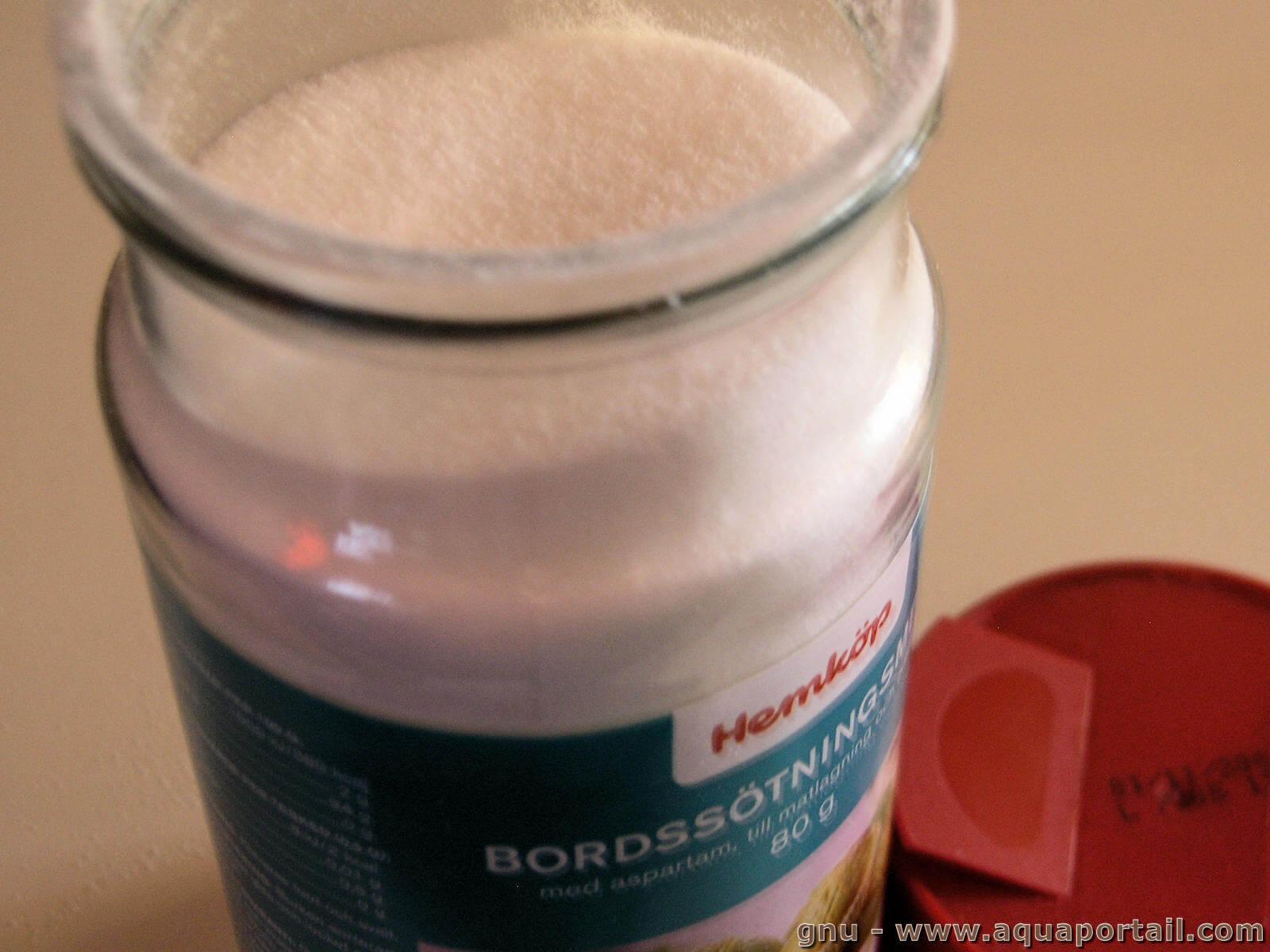
This sweetener is made from aspartame powder.
Explanations
An important class of sugar substitutes is known as high-intensity sweeteners (such as maltitol, for example). These have a sweetness several times greater than that of ordinary table sugar. Consequently, far less sweetener is needed, and the caloric contribution is often negligible. The sensation of sweetness produced by these compounds sometimes differs noticeably from sucrose, so they are often used in complex blends that provide a more natural sweet taste.
If the replaced sucrose (or other sugar) contributed to the product's texture, a bulking agent is often required. This is seen in soft drinks labeled "diet" or "light", which contain artificial sweeteners and often have noticeably different palatability, or in tabletop sugar substitutes that blend maltodextrins with a high-intensity sweetener to provide a satisfactory texture.
In the United States and most European countries, the three main compounds used as sugar substitutes are saccharin, aspartame, and sucralose. Cyclamate and plant-based sweeteners such as stevia are widely used in many other countries.
In the United States, six high-intensity sweeteners have been approved for use: saccharin, aspartame, sucralose, neotame, acesulfame K (acesulfame potassium), and neohesperidin dihydrochalcone (NHDC). Controversy exists regarding whether artificial sweeteners pose a health risk, fueled by anecdotal reports and occasionally poorly controlled studies publicized via the Internet and popular press. Scientifically controlled, peer-reviewed studies have consistently failed to produce evidence of adverse effects caused by consuming these products. There is also an herbal supplement, stevia, used as a sweetener; debate surrounds the safety of this plant-based supplement, despite being natural, and its approval as a sugar substitute has been contested.
⭐ Most sweeteners approved for food use are artificially synthesized compounds. However, certain natural sugar substitutes are known, notably sorbitol and xylitol (polyalcohols), found in berries, fruits, vegetables, and mushrooms. Extracting these from fruits and vegetables is not commercially viable, so they are produced by catalytic hydrogenation of the appropriate reducing sugar. For example, xylose is converted into xylitol, lactose into lactitol, and glucose into sorbitol. Eight natural substitutes are known, though they have not yet received formal approval for food use.
✅ Certain non-sugar sweeteners are polyols, also called "sugar alcohols". These are generally less sweet than sucrose, yet have similar bulking properties and can be used across a wide range of food products. As with all food products, developing a formulation to replace sucrose is a complex, proprietary process.
Use of artificial sweeteners by the food industry
The food and beverage industry increasingly replaces sugar or corn syrup with artificial sweeteners in many products traditionally containing sugar. In the United Kingdom, for instance, it is now nearly impossible to find soft drinks without artificial sweeteners in supermarkets, and even items like pickled beets and gherkins are increasingly artificially sweetened.
Although the profit margin on artificial sweeteners is extremely high for manufacturers, they still cost the food industry only a fraction of the price of sugar and corn syrup. Corn syrup was introduced by the industry as an economical alternative to sugar. Unsurprisingly, the food industry promotes its "diet" or "light" products, encouraging consumer shifts toward these artificially sweetened items, which are even more profitable.
According to market analyst Mintel, 3,920 products containing artificial sweeteners were launched in the United States between 2000 and 2005; in 2004 alone, 1,649 artificially sweetened products were introduced. According to market analyst Freedonia, the U.S. artificial sweetener market grew by about 8% per year to reach $189 million in 2008.
In the United States, aspartame is currently the most widely used sweetener in the food industry, its price having dropped sharply since Monsanto's patent expired in 1992. However, sucralose may soon overtake Tate & Lyle's patent position. According to Morgan Stanley, this could mean a 30% drop in the price of sucralose.
Reasons for using sweeteners
Individuals use a sweetener (sugar substitute) for five main reasons:
- to assist with weight loss: some people choose to limit energy intake by replacing high-calorie sugar or corn syrup with sweeteners providing little or no energy. This allows them to eat the same foods as usual while losing weight and avoiding other problems linked to excessive calorie consumption. However, a study conducted by the University of Texas Health Science Center at San Antonio showed that rather than promoting weight loss, diet beverages were a marker of increased weight gain and obesity. More recent epidemiological studies indicate there is no convincing evidence linking non-nutritive sweetener consumption to increased body weight (Fernstrom 2015).
- dental care: sugar substitutes are not harmful to teeth, as they are not fermented by the microflora of dental plaque.
- diabetes mellitus: diabetics have difficulty regulating their blood sugar. By limiting sugar intake with artificial sweeteners, they can enjoy a varied diet while controlling sugar consumption.
- reactive hypoglycemia: individuals with reactive hypoglycemia produce excess insulin, causing rapid absorption of glucose into the bloodstream. This drops blood glucose below the level needed for proper body and brain function. Consequently, like diabetics, these patients must avoid foods that spike blood glucose, such as white bread, and often choose artificial sweeteners.
- avoiding processed foods: some people may choose to replace refined white sugar with a less refined sugar, such as fruit juice or maple syrup.
Health controversies regarding sweeteners
Controversy exists regarding alleged health risks of artificial sweeteners such as saccharin and aspartame. Some studies showed they caused brain tumors as well as lymphatic cancers in laboratory animals and suggested that saccharin caused bladder cancer in laboratory animals, though this is unlikely to affect humans because the putative mechanism by which saccharin is carcinogenic in mice does not exist in humans.
The FDA (Food and Drug Administration) determined in 1981 that aspartame could be used safely in food, though only after having been rejected for many years. It was also mandated that all products containing aspartame carry a warning for phenylketonurics, indicating that the sweetener contains phenylalanine (as do many foods).
Synonyms, antonyms
Spanish translation: edulcorante
1 synonym (similar meaning) for "sugar substitute":
0 antonyms (opposite meaning).
Related words and expressions to SUGAR SUBSTITUTE are directly connected by general or specific meaning.
The expression SUGAR SUBSTITUTE is listed on page 1 of words starting with S in the dictionary glossary.
Related to "sugar substitute"
saccharide

A saccharide is a carbohydrate, a biomolecule composed of carbon, hydrogen, and oxygen atoms, usually with a hydrogen-to-oxygen atomic ratio of 2 :1.
sagittocyst

A sagittocyst is a capsule containing a spindle-shaped needle produced by epidermal cells of certain flatworms (acoels).
salt marsh lamb

A salt marsh lamb (pré-salé) is a sheep that grazes habitually on coastal salt marshes, feeding on salt-tolerant grasses and herbs.
saltwater treatment

The saltwater bath method, or aquarium salt treatment, helps halt potential external infections via osmotic shock.
