
Nitrogen Compounds Ammonium-Nitrites-Nitrates: Biological Filtration: Expert Aquarium Manual
Nitrogen compounds and the ammonium-nitrite-nitrate nitrogen cycle: biological purification
For the advanced aquarist interested in aquariology, nitrogen (N) is a fundamental building block of living matter because it characterizes proteins—quaternary chemical compounds [Carbon (C), Hydrogen (H), Oxygen (O), and Nitrogen (N)] of vital importance to all living organisms.
With only a few exceptions (species discovered within the past 25 years), these 4 elements are indispensable to both terrestrial and aquatic life.
Nitrogen passes through successive stages during water purification: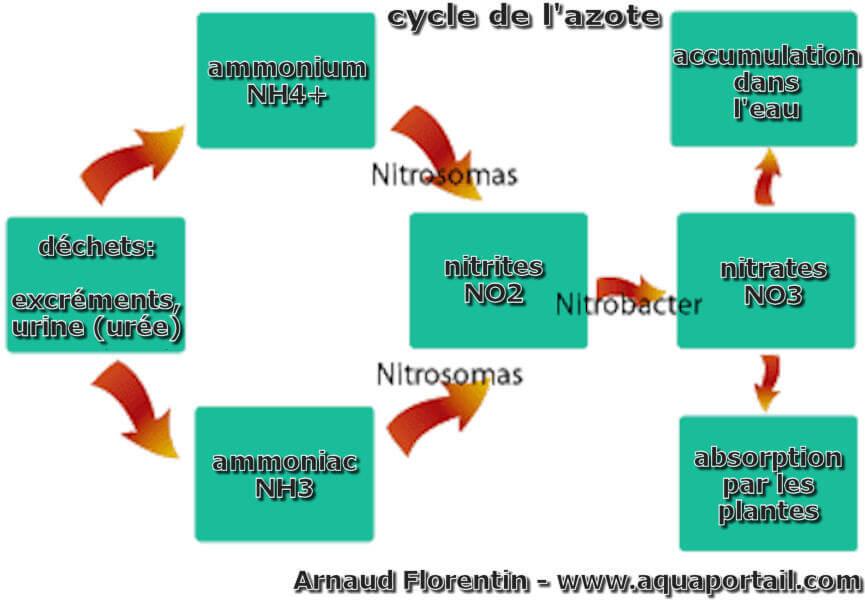
The nitrogen cycle encompasses all forms of mineral nitrogen: ammonium, ammonia, nitrites, and nitrates.
Nitrogen in water
In water—and therefore in the aquarium—nitrogen occurs in dissolved gas form (negligible biologically), in organic form (proteins, nucleic acids, urea), and in mineral form as ammonia compounds: unionized molecular ammonia (NH3), the most toxic to living organisms, or ionized ammonium (NH4), roughly 100 times less toxic; nitrites (NO2), toxic to fish; and nitrates (NO3), which are comparatively harmless.
Mineral nitrogen is assimilated by bacteria and plants (phytoplankton and higher aquatic plants). Synthesized plant proteins then enter the food web directly (herbivores) or indirectly (carnivores), where animals metabolize them either to rebuild cellular proteins or to generate cellular energy.
Organic nitrogen compounds thus enter the water via urine, feces, and dead plant or animal matter. Specialized bacteria break them down into ammonium compounds (NH4), nitrites (NO2), and ultimately nitrates (NO3), supplying plants with bioavailable nitrogen nutrients (fertilizer) that fuel growth.
1st stage: ammonification
The first, highly complex stage of breaking down organic nitrogenous waste (ammonia excreted across fish gills, feces, decaying plant matter, carcasses, uneaten food) is carried out by a wide range of microorganisms—including bacteria of the genera Bacillus, Bacterium, and Micrococcus, as well as Pseudomonadaceae and Vibrionaceae. This process produces amino acids via ammonification, ammonium compounds via deamination, and carbon dioxide.
2nd stage: nitrification
Ammonium compounds are next processed by a distinct group of nitrifying microorganisms. A first bacterial group oxidizes ammonium into nitrous acid (HNO2), which immediately reacts with available bases (sodium, potassium, calcium) to form nitrite salts (NO2). Nitrifying bacteria such as the genus Nitrosomonas (round cells motile via a single flagellum) belong to this group; this first biochemical oxidation step from ammonia to nitrous acid is called nitrosation.
At the same time, a second group of bacteria—such as the genus Nitrobacter (rod-shaped and non-motile)—oxidizes nitrous acid and nitrites into nitric acid, which reacts with bases to form sodium, potassium, and calcium nitrates (NO3). This second biochemical oxidation step is called nitratation. Together, ammonification and nitrification convert organic nitrogen back into a mineral form readily absorbed by aquatic plants.
All of these transformations are driven by enzymes secreted by specialized autotrophic organisms that derive all the energy needed to synthesize cellular matter from inorganic compounds. Through chemosynthesis, these bacteria require no light—unlike organisms relying on photosynthesis. Indifferent to lighting, they are strictly oxygen-hungry and sensitive to water quality: chemical pollutants, antibiotics, certain medications, or unfavorable conditions (low oxygen, lack of trace elements, abnormal pH drops) quickly impair them.
As a reminder, heterotrophic organisms depend closely on autotrophs for survival. Furthermore, ammonia compounds cause gill filaments to swell and fuse together, drastically reducing respiratory surface area and leading to suffocation, while nitrites bind to blood hemoglobin and prevent it from carrying oxygen.
Overview of the main stages of the nitrogen cycle:
Bacterial colonization develops progressively as the nitrogen cycle establishes itself, with a mini-spike occurring whenever new bioload—such as fish or extra food—is introduced.
As soon as the first fish are added, ammonia/ammonium levels rise and peak around day 7 in a new aquarium, fueling the growth of nitrosating bacteria. From day 7 onward, these colonies become large enough to oxidize ammonia as fast as it is produced, so ammonia levels fall while nitrites climb. Around day 17, nitratating bacteria become abundant enough to oxidize nitrites into nitrates, causing nitrite levels to drop steadily as nitrates rise. By day 24, all bacterial colonies are established and the stages of nitrification run simultaneously: toxic intermediate compounds no longer accumulate, while nitrates continue to build up and must be kept in check through regular water changes.
For instance, high nitrate levels combined with low oxygen can trigger an uncontrolled bloom of primarily anaerobic denitrifying bacteria that reduce nitrates back into nitrites and ammonia, even releasing nitrogen gas. While harmless in nature (where nitrogen-fixing bacteria such as Azotobacter recapture atmospheric nitrogen), in a closed aquarium or pond those intermediate nitrites and ammonia are acutely lethal to fish and even plants. Whereas nitrites and nitrates occur only in trace amounts in natural waters (nitrates rarely exceed 1 mg/L even in isolated bays), closed aquariums with limited water volume, heavy fish stocking, and sparse plants can accumulate up to 1,000 mg/L of nitrates within a year without regular water changes—or when topped up with unsuitable tap water treated via chlorination or chloramination.
Regular water testing is therefore essential, especially when commissioning a new tank. Stocking and feeding trigger the initial wave of organic nitrogen waste, followed sequentially in the sterile substrate by ammonifying bacteria (first toxic spike), nitrosating bacteria (second toxic spike), and finally nitratation.
It often takes several weeks for biological equilibrium to stabilize so all stages run concurrently. Temporary spikes of ammonium and nitrites can still occur after overfeeding or partial disruption of the biofilter (deep gravel vacuuming or antibiotic treatments). Chronic ammonium or nitrite levels, however, indicate a systemic imbalance—usually caused by overstocking (accounting for fish count, adult size, activity level, and feeding volume) or insufficient plant and bacterial capacity.
Ammonia toxicity is also influenced by colloidal substances such as albumin and by startup conditions common in new tanks: elevated pH and abundant organic matter.
A fourth option—dosing freeze-dried or bottled nitrifying bacteria—has shown positive results in both freshwater and marine tanks when protocols are followed strictly. However, many commercial strains target mainly the nitrite-to-nitrate step, leaving initial ammonia control incomplete.
Transferring water from an established tank is largely ineffective because only about 1% of nitrifying bacteria float freely in the water column; the vast majority live attached to solid surfaces.
A simple, proven method is to transfer unwashed filter media (rinsed no more than a week prior), hardscape pieces, and a handful of substrate from a healthy established aquarium into the new tank.
Consequences for biological water purification
Because establishing biological filtration is mandatory for a healthy aquarium—and because toxic intermediates (ammonia and nitrites, which block oxygen transport) appear sequentially in a biologically sterile new tank—a few simple precautions are essential.
At startup, 3 practical approaches can be used:
- "Seed" the new aquarium with top-layer substrate or unwashed filter media from a healthy, established tank.
- Scald a mussel, mince it finely, and add it along with its broth to the aquarium, then wait about 20 days before adding fish.
- Stock very lightly (2 or 3 notably hardy fish) and feed sparingly for about 20 days before adding any more livestock.
Ammonia toxicity varies by species and depends heavily on temperature and pH. Marine fish are generally more vulnerable than freshwater species, so hardy pioneer species should always be chosen first when possible. In marine setups, invertebrates (especially large crustaceans) produce significant waste while remaining relatively tolerant of these toxins.
Note: Standard test kits measure total ammonium (NH4), yet a critical equilibrium exists between mildly toxic ionized NH4+ and unionized dissolved gas NH3 (free ammonia), which is 100 times more toxic. The unionized NH3 fraction rises with temperature and pH: negligible below pH 7, alarming from pH 7.5 upward, and acutely dangerous above pH 8.5.
In inland aquaculture, recommended safe thresholds for recirculating water are:
- NH3 (Free ammonia): 0.005 mg/L (fry); 0.075 mg/L (hardy juvenile fish).
- NH4 (Ammonium): 0.5 mg/L (fry); 0.75 mg/L (hardy juvenile fish).
- NO2 (Nitrites): 0.1 mg/L (legal freshwater threshold in France).
- NO3 (Nitrates): non-toxic at low levels.
In marine aquariums—given an average temperature of 25 °C, pH above 8, the resulting NH3 ↔ NH4 dissociation ratio, green algae nutrient uptake, and practical experience—the following thresholds apply:
- NH4+ (Ammonium): 0.1 mg/L (corresponding roughly to a potential 0.01 mg/L of NH3 at 25 °C and pH 8.5).
- NO2 (Nitrites): 0.1 mg/L.
- NO3 (Nitrates): 10 mg/L (maintained via slow, continuous water renewal).
Under these typical conditions, the ammonia threshold (0.01 mg/L) is ten times stricter than that for nitrites (0.1 mg/L), reflecting roughly tenfold higher average toxicity.
Throughout the entire cycling period, pH must be kept stable!
When nitrites rise significantly, acute poisoning occurs as soon as concentrations exceed 3 mg/L.
Because ammonia toxicity surges at high pH, a new aquarium should ideally be cycled with slightly acidic to neutral water rather than alkaline water.
In seawater, where pH is naturally high, the risk of toxic molecular ammonia (NH3) is permanent.
In inland freshwater, pH also tends to drift upward during initial cycling, creating a high risk of free ammonia. Conversely, in water buffered near neutrality (pH 6.5 to 7.3), an ammonium spike is far less dangerous.
In both environments, however, the subsequent nitrite spike poses a second, pH-independent hazard.
Whenever a nitrite spike is recorded, it means livestock have already endured an ammonia phase—and ammonium itself carries species-specific toxicity.
At high pH, most fish will not even survive the initial ammonia phase and perish long before nitrites appear.
Note: When starting a new aquarium (or garden pond), avoid exposing valuable livestock to cycling spikes whenever possible.
After roughly 20 days at 25 °C (in coldwater tanks at 10 °C, allow 6 to 8 weeks or longer—take care with goldfish!), organic breakdown proceeds concurrently, bacterial colonies are established, and toxic intermediates drop to trace levels (below 0.1 mg/L on average).
Nitrates, however, continue accumulating steadily without water changes. While not acutely lethal on their own until roughly 300–400 mg/L, levels above 100 mg/L should be avoided—especially in neglected tanks—because they act as a ticking time bomb that can revert to nitrites and ammonia under low-oxygen conditions, while concentrations above 25 mg/L inhibit the growth of many aquatic plants.
In an aquarium running smoothly for more than a month, ammonia and nitrite poisoning risks are virtually zero, and healthy fish easily weather minor temporary bumps after heavy feeding or adding new tankmates. A dynamic balance continuously adjusts bacterial biomass to organic waste load: when waste rises, existing colonies multiply rapidly and restore equilibrium within hours.
By contrast, if an aquarist makes the mistake of thoroughly washing all filter media, decor, and top substrate layers on the same day, a severe crash will follow days later because the tank's biological filtration has been wiped out!
Whenever deep cleaning is needed, clean decor and substrate in staggered stages from one week to the next.
Another practical lesson involves long-distance fish shipping: fish continue respiring and excreting waste in transit bags, causing ammonia to climb rapidly. If transferred upon arrival into well-cycled, balanced tanks, they recover quickly with minimal stress.
Unfortunately, poorly equipped importers or retailers sometimes keep bare-bottom holding tanks scrubbed completely sterile for perceived "hygiene" or easier netting, stripping away nitrifying bacteria.
Two prudent strategies follow:
- Be present when shipments arrive and acclimate your chosen fish directly into your own mature system.
- Wait about two weeks before buying, selecting hardy survivors tolerant of ammonia! By then a nitrite test may still read negative—nitrites typically peak 10 to 15 days after stocking at 25 °C—whereas an ammonia test will reveal the true water quality.
Cloudy milky water, persistent surface foam clinging to the glass, and a sharp ammonia odor above the tank are immediate warning signs of a system in distress.
The safest way to minimize risk is to buy from a reputable, well-equipped dealer whose tanks display active, healthy fish in crystal-clear, odor-free water—the best guarantee for both aquarist and fish.