
Calculate your BMI:
Calculate your BMI:
You can use the BMI (Body Mass Index) calculator below or the general chart to quickly estimate your BMI or ideal weight range. The BMI calculation makes no distinction between sexes (men and women), age (from 7 to 107 years old...), or lifestyle (physical activity, sedentary habits).
A normal BMI is between 18.5 and 24.9.
BMI Definition:
BMI stands for Body Mass Index. It is a formula used to assess healthy body weight relative to height in meters (or centimeters), indicating whether you are underweight, normal weight, overweight, or obese.
Your ideal body weight range can be estimated using BMI, which accounts for your height. The resulting BMI falls into one of four categories:- Underweight: BMI = below 18.5;
- Normal - Healthy: BMI = 18.5 to 24.9;
- Overweight: BMI = 25.0 to 29.9;
- Obesity: BMI = 30.0 and above.
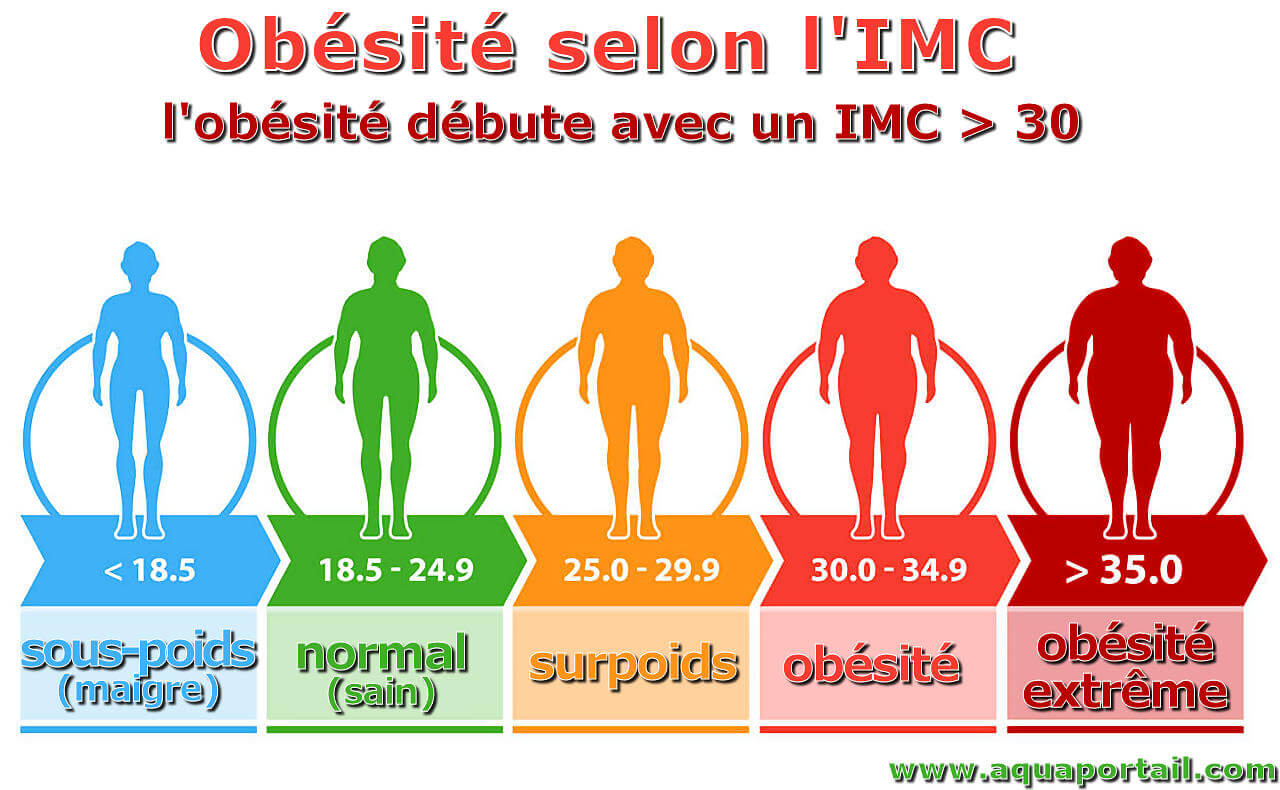
Quickly visualize your BMI to see whether it falls in the overweight or obese range.
BMI provides a numerical health indicator based on your height and weight. As your BMI increases, so does your risk of developing weight-related conditions such as cardiovascular disease and type 2 diabetes.
A high BMI is also a recognized risk factor for severe forms of COVID-19; a BMI over 30 indicates clinical obesity.
The BMI calculation formula is: BMI = weight(kg) / (height(m) × height(m)) or BMI = weight(kg) / (height(cm) / 100)2.
BMI Chart (Height-to-Weight Ratio):
Quickly estimate your BMI on this chart, or check which weight range is recommended for your height to stay "in the green."
BMI (Body Mass Index) Chart, Height and Weight Ratio: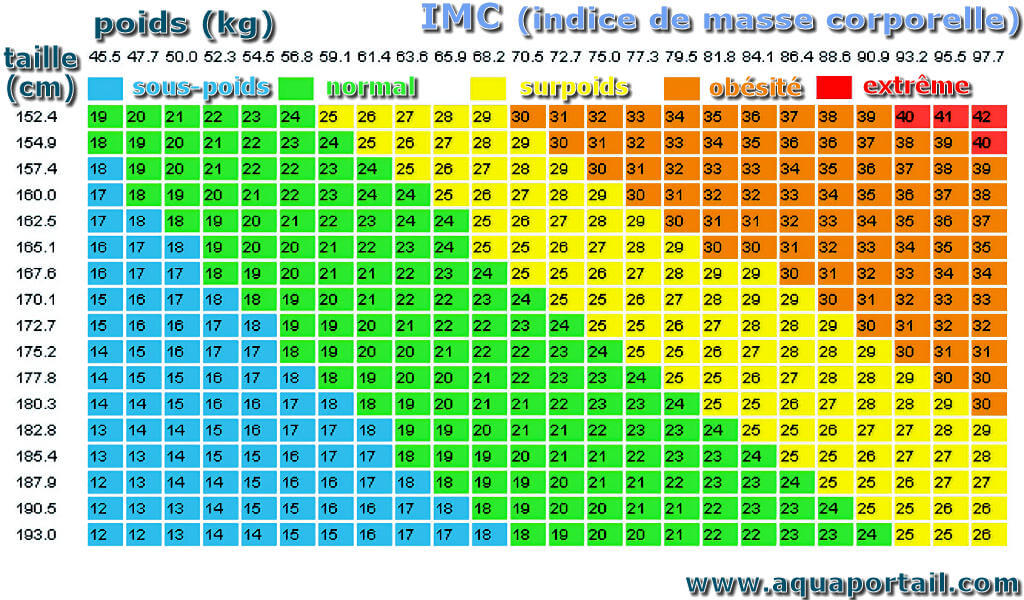
In this height-to-weight BMI chart, normal BMIs appear in green, underweight in light blue, overweight in yellow, obese in orange, and severely obese in red.
Benefits of BMI:
BMI offers several advantages thanks to its simplicity:- Indicates normal weight, overweight, obesity, or undernutrition.
- Provides a quick check on whether your weight is in a healthy range.
- Useful as a screening tool for the general population.
- Requires no complex measurement equipment or techniques.
Limitations and Drawbacks of BMI:
Body Mass Index (BMI) does not distinguish between fat mass and muscle mass, nor does it show where excess fat is distributed on the body.
BMI may overestimate body fat in athletes and individuals with high muscle mass, making it less reliable for heavily trained individuals.
Conversely, BMI may underestimate body fat in older adults or individuals who have lost muscle mass.
To complement BMI, waist circumference is a helpful additional metric because it accounts for sex (though still not age or height): an adult woman's waist circumference should ideally stay below 80 cm (31.5 in), and an adult man's below 94 cm (37 in).
BMI vs. Body Fat Percentage:
Both Body Mass Index (BMI) and Body Fat Percentage (BFP) provide useful health insights, with ongoing research clarifying how body fat percentage correlates with disease risk.
Studies show that body fat percentage can be a more accurate predictor of weight-related health risks than BMI alone.
BMI is a quick, straightforward calculation based solely on height and total weight (without separating fat from muscle), whereas body fat testing is a more detailed assessment based on actual adipose tissue percentage.
Choosing whether to track your health with BMI or body fat percentage depends on your lifestyle and fitness level. Here are the key trade-offs:
Body fat percentage is typically measured using skinfold calipers at specific body sites and applying standardized anthropometric equations, or via clinical bioelectrical impedance.
The advantages of Body Fat Percentage (BFP) are:
- Assesses normal weight, overweight, or obesity more specifically for the individual.
- Estimates the actual proportion of body fat.
- Combined with lean-mass formulas, helps track muscle mass separately.
- Works well for the general population and is much more accurate for physically fit individuals.
Conversely, the drawbacks of BFP are:
- Measuring BFP accurately is more involved—it requires either a medical-grade bioimpedance analyzer (not inexpensive consumer scales) or trained skinfold caliper technique.
- Athletes and heavily muscled individuals benefit most from tracking body fat percentage over time rather than relying on BMI.