
Acidity or pH, Alkaline Reserve and Buffer Capacity of Aquarium Water: Expert Aquarium Manual
pH: acidity, neutrality, alkaline reserve, and buffer capacity
Physical examination (color, odor, and taste) of water during a hydrobiological analysis is always paired with measuring the potential of hydrogen (pH). Alongside other metrics, this value gives an immediate indication of both the physicochemical and biological qualities of water.
Important: Inland freshwater should be—and ideally remain—crystal clear, colorless, odorless, tasteless, and close to neutral whenever possible.
pH curve and scale as a function of NaOH: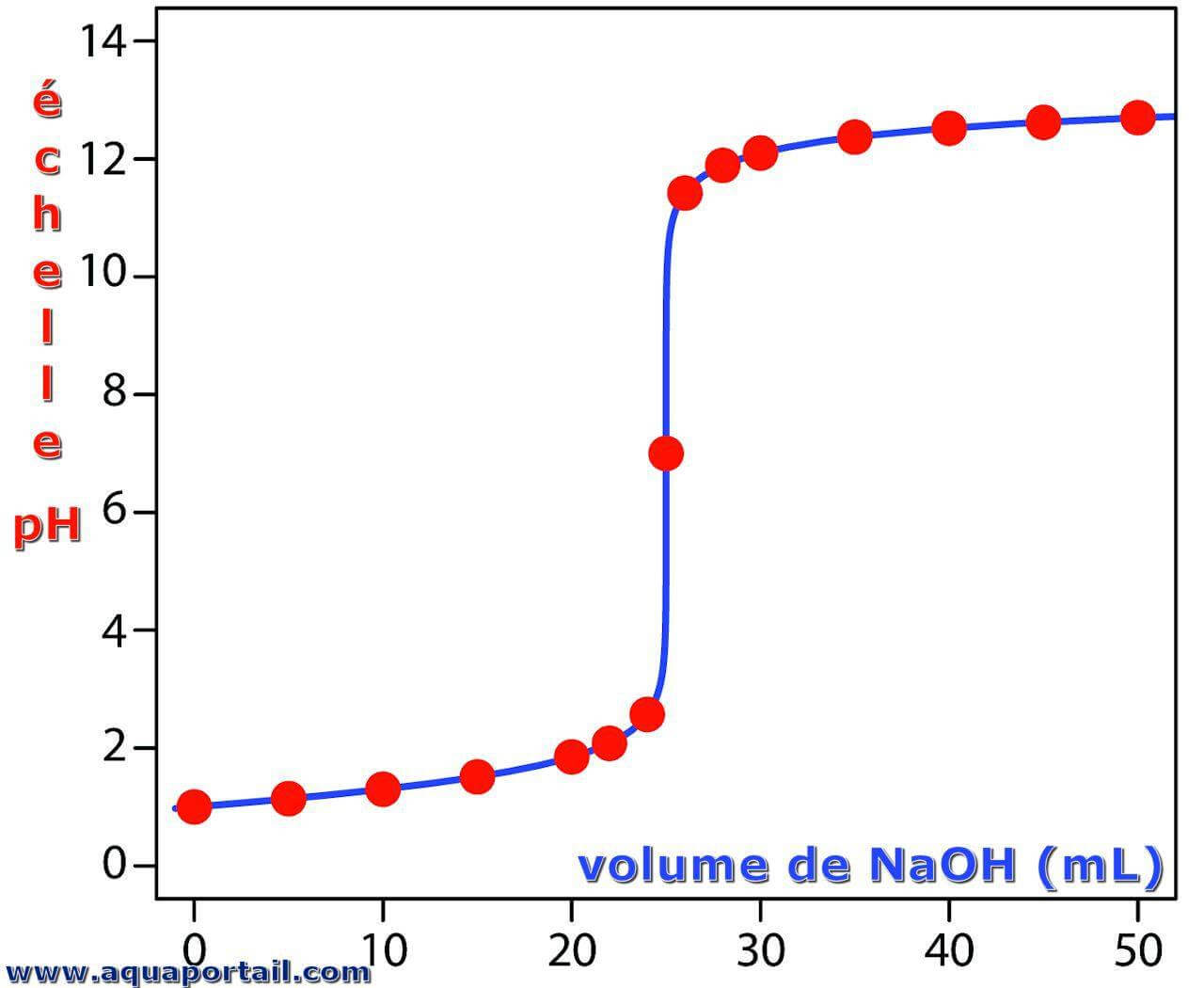
The pH curve is logarithmic: it shifts rapidly around the neutral midpoint at pH = 7.0.
Measuring pH
Water pH is measured either electronically with a meter or colorimetrically using a pH test. Schematically, it reflects the concentration of hydrogen ions (H+) in solution. Water is neutral when H+ equals hydroxide ions (OH-) at 0.000001 mg/L, written simply as pH 7. Acidic water contains more hydrogen ions—theoretically up to 1 g/L at pH 0—whereas minimum hydrogen ion concentration corresponds to pH 14. Mathematically, pH is the negative base-10 logarithm of hydrogen ion concentration (H+) expressed in grams per liter.
These extreme values (0 and 14) only occur in concentrated solutions of strong acids or strong bases; most biological processes take place near neutrality.
Remember that each single-unit shift on the pH scale represents a tenfold change in acidity or alkalinity. Water at pH 6 is 10 times more acidic than pH 7, while water at pH 9 is 10 × 10 = 100 times more alkaline than pH 7!
Numerous physical factors (light, temperature), chemical factors (carbon dioxide, dissolved oxygen), and biological factors (plants, livestock) influence pH—and are in turn influenced by it.
Consequently, pH serves as a reliable indicator of overall chemical and biological stability in any aquarium, which is why monitoring it is so useful in fishkeeping.
Never treat pH as a cure-all, however—view it as a compass showing whether you are on the right track or heading toward trouble. In general, run 2 daily tests following this protocol for testing aquarium pH.
pH values in inland freshwater aquariums
Seawater pH is naturally stabilized by dissolved marine salts and requires little intervention. Conversely, in the exceptionally soft, acidic waters of certain Amazon tributaries, a pH of 4.5 to 5 is completely normal. This low pH stems from weak humic acids: because the water lacks buffering minerals (calcium carbonate in particular), even trace acids dissociate readily and pH drops naturally without harming native fish adapted to this ecological factor.
In a home aquarium, however—especially with moderately hard to hard water—such a sharp pH drop is abnormal and typically caused by strong acids, prompting fish to refuse food and behave erratically.
To be meaningful, pH readings must always be taken at the same times each day. Without a continuous logging pH meter, plot a diurnal (nycthemeral) curve by testing just before the lights turn on and again just before lights-out; these two readings take priority over any other time of day.
Biological interactions with water pH
Since most biological activity thrives between pH 6 and pH 8, any abnormal drift away from your tank's established baseline signals declining stability and calls for reviewing equipment, stocking density, or water chemistry.
Most of these issues are easily prevented through regular—ideally slow and steady—water changes, sensible stocking, and restrained feeding.
We emphasize these seemingly complex principles so aquarists avoid working against the physical and biological laws governing living organisms and their environment.
A major source of acidity in an aquarium is carbon dioxide respired by fish. As noted in the dissolved oxygen chapter, exhaled CO2 dissolves in water even more readily than oxygen and becomes toxic to fish at elevated levels—though several natural pathways help remove it.
pH and CO2: intertwined!
Part of the dissolved CO2 reacts with water to form carbonic acid, which partially dissociates into hydrogen ions and lowers pH. Much of this carbonic acid reacts with available calcium carbonate to form soluble calcium bicarbonate. Here temporary hardness (KH), tied to carbonates, acts as a buffer preventing fish-respired CO2 from forming excess carbonic acid and crashing the pH.
In effect, carbon dioxide is buffered by calcium carbonate (limestone) as soluble calcium bicarbonate.
Identical processes explain water hardness in nature: water evaporating off the ocean is essentially pure, demineralized distilled water.
As raindrops fall through the atmosphere, they absorb carbon dioxide, and as water percolates through topsoil it picks up additional CO2 respired by soil microorganisms. When this mildly acidic water meets calcareous rock, carbonic acid dissolves limestone into soluble calcium bicarbonate.
Under high pressure in deep aquifers, water can hold far more CO2 and dissolved bicarbonate than at atmospheric pressure; once it emerges at a spring, excess CO2 outgasses rapidly and calcium carbonate precipitates back out (forming travertine or petrifying springs).
The exact same reaction occurs when boiling water or around an aquarium heater: heating drives off dissolved CO2, causing calcium carbonate scale to precipitate. Without carbonate buffering, pH fluctuates easily.
A similar effect also happens in densely planted aquariums under intense sunlight or artificial lighting: plants can strip all free dissolved CO2 and then extract carbon from calcium bicarbonate (biogenic decalcification), causing calcium carbonate precipitation and a sharp rise in pH.
An excessive pH rise likewise drives off free dissolved CO2—above pH 8.5, virtually no free CO2 remains in solution, marking an upper pH ceiling best avoided.
In newly set up tanks—especially with inland waters—pH commonly climbs toward or slightly above 8.5 because fresh tap water is often bicarbonate-saturated. To avoid issues with hard tap water, blend or fill with reverse osmosis (RO) water.
These overlapping chemical shifts can discourage newcomers, who sometimes mistake normal startup fluctuations for fatal errors, drain and disinfect the entire tank and sand, and start over—only to encounter the exact same cycle weeks later. Patience and methodical testing easily carry a tank through startup!
As we have seen, excess CO2 is partly buffered via carbonic acid neutralization.
KH, pH, and CO2 are so tightly linked in freshwater (in the absence of peat filtration) that accurately measuring any two lets you calculate the third—particularly dissolved CO2, which is difficult to measure directly.
The accepted upper safe limit is 60 mg/L of CO2, which defines the lowest safe pH target for any given KH level.
Water circulation and aeration therefore serve a dual purpose: reoxygenating the water and off-gassing excess CO2, helping stabilize pH.
Explaining pH measurement methods
Colorimetric methods: litmus paper strips are mentioned only in passing—they are too imprecise for aquarium water, which is far too dilute and weakly buffered.
Electrometric method: highly accurate and convenient, though more expensive. Purchasing a digital pH meter (several hobby models are reasonably priced) is worthwhile for clubs, shops, or dedicated aquarists. Because pH is best measured "in situ" before gas exchange alters ionic balance, a portable meter is ideal; otherwise, collect water in a completely full, tightly sealed glass or plastic bottle and test promptly.
In seawater, use a specialized electrode compensated for sodium ion interference.
Always verify meter accuracy regularly and calibrate with standard acidic and alkaline laboratory buffer solutions.
Adjusting aquarium pH? Lowering and raising
Chemical pH adjusters exist, though we mention them only for reference since routine use is discouraged outside emergencies (such as ammonia toxicity).
Sodium bicarbonate raises the pH of hard water.
Monosodium phosphate lowers the pH of hard water.
Prevention beats treating symptoms: a well-maintained tank naturally sits near neutral or slightly acidic in soft water, and slightly alkaline in hard water thanks to limestone buffering capacity. Seawater maintains a higher pH around 8.0–8.3 due to its high alkaline reserve from abundant dissolved salts.
Conversely, alkaline soft water (significantly above 7) or acidic hard water (significantly below 7) is a red flag.
To lower soft-water pH (helpful for spawning certain species), filter over peat. Filtering hard water over peat is pointless: peat's mild acidifying capacity is overwhelmed by hard water's carbonate buffer, and acidic hard water is biologically unnatural.
Peat's real value lies in giving soft water gentle acidic buffering and stability. You can test peat quality by filtering 1 to 2 liters of very soft or demineralized water of known pH through a 100 to 200 cm3 sample of peat for 24 hours, measuring pH immediately afterward, letting the water stand for 24–48 hours, and testing a third time: quality peat with genuine acidic buffering will hold the same acidic reading.
Notes on pH
Finally, remember that pH measures only H+ ion concentration resulting from acid dissociation—knowing the accompanying anion matters just as much. Chloride ions (Cl-) dissociated from hydrochloric acid (HCl) affect fish physiology very differently than nitrate ions (NO3-) from nitric acid (HNO3) or weak organic acids.
Thus, at an identical pH of 4, a natural humic acid blackwater stream poses no harm to adapted fish, whereas a mineral acid like hydrochloric acid at pH 4 is lethal.