
Lighting: Marine Reef Aquarium Manual
Marine lighting: lux and lumens must come in both quantity and quality
Note that watts-per-liter guidelines (very rough and widely debated) are calculated from the gross external volume of the aquarium and assume a 10,000 K color temperature for the emission spectrum. These figures must be adjusted based on tank height, which remains the primary factor determining minimum wattage (depending on beam spread) and lamp color temperature.
Glass cover lids should be strictly avoided in marine aquariums (except possibly on pure F.O. setups) because they block far too much light intensity (at least 20% depending on glass thickness) and alter the light spectrum penetrating the water—filtering out the crucial lower wavelengths in the UV and blue range, and blue is precisely what corals need most!
HQI metal halide lamps: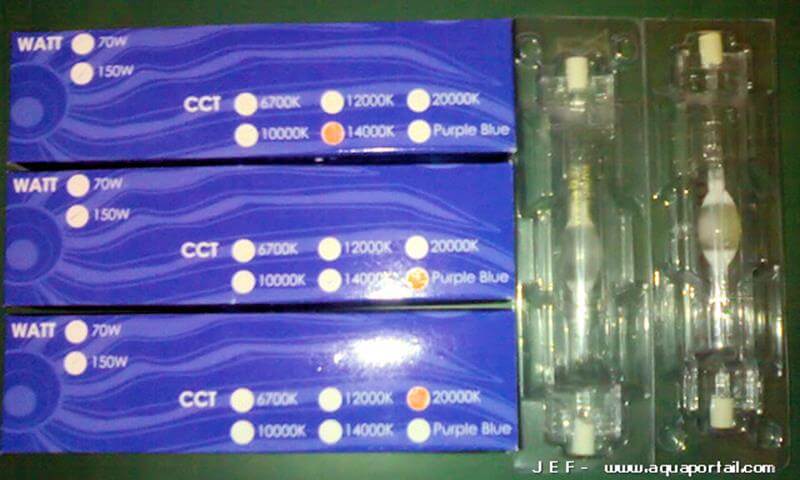
HQI metal halide bulbs have become less common since the rise of modern LED lighting.
Lighting type and output depend on your aquarium setup
- A Fish Only (F.O.) tank only needs enough light to view the fish comfortably—around ½ W/L (0.5 W/L) is usually sufficient.
- If you use live rock (LR) in your aquarium, aim for no less than ¾ W/L (0.75 W/L), and more is better—this applies even in a fish-only system with live rock.
- Lighting for soft corals (paired with live rock) should be at least 1 W/L.
- Stony corals, giant clams, and host anemones demand much higher output—ideally 1.5 to 2 W/L depending on water depth. Output above 2 W/L (> 2.5 W/L) allows keeping the most light-demanding SPS stony coral species!
Lighting technology also matters
- Standard Normal Output (NO) fluorescent tubes (T8 or T5) are used primarily over F.O. or F.O. with live rock tanks. T5 HO fixtures—and even multi-tube T8 arrays over shallow tanks—can also grow corals well, provided every tube is fitted with a clean, polished reflector. Because fluorescent tubes emit light in 360 degrees, an unreflected tube delivers at best 40–45% of its output into the water (while a white canopy hood helps very little); a clean parabolic reflector boosts usable output to 80–90%, though salt spray requires frequent wiping.
- Very High Output (VHO) fluorescent tubes—such as classic T12 lamps—are older technology and increasingly hard to source, though the Philips TL03 super-actinic 140 W tube (150 cm) remains a notable benchmark.
- HQI metal halide (MH) lamps rank among the most intense light sources available, closely rivaling natural sunlight. They excel over deep aquariums and were long indispensable for SPS reefs, giant clams, and anemones. Another clear advantage of HQI lamps is broad color rendition extending into ultraviolet (UV); because of UV emission, HQI fixtures must always be mounted at least 30 cm above the water surface (or fitted with a UV-filtering tempered silicate glass shield) so they do not burn coral tissue.
- Power Compact (PC) fluorescent lamps, although once widespread in North America, saw limited distribution in Europe outside low-wattage nano-reef fixtures—a pity, as their compact profile offered a neat alternative to HQI where overhead clearance was tight.
The "color temperature" of a light source—expressed in Kelvin (K)—is equally critical. Water rapidly absorbs long-wavelength colors (red first, then orange, then yellow) in the upper meters of the ocean, while shorter wavelengths (green, blue, and violet) penetrate much deeper. Descending below the surface, red vanishes first and yellow disappears beyond 5 m (meaning a yellow fish swimming at 6 or 7 meters appears gray because there is no yellow sunlight left for its scales to reflect across the visible spectrum), leaving violet as the last visible color at depth. Light absorption depends on water molecules themselves rather than salinity (nearly identical to distilled water), compounded by dissolved yellow organic compounds (gelbstoff) and suspended particulates such as calcareous silt or phytoplankton.
Low Kelvin ratings correspond to long-wavelength, reddish light, whereas high Kelvin ratings correspond to short-wavelength, blue-dominant light. A reddish sunset sits around 2,500 to 3,900 K, overcast daylight around 5,000 K, and direct midday sunlight at the water surface averages roughly 6,500 K (varying with latitude and season), while a clear deep-blue sky can exceed 20,000 K.
Taking 6,500 K as a natural average value at the surface, red wavelengths are filtered out within the first few decimeters of water; from 1 m down to about 10 m, underwater light shifts closer to 10,000 K, and below 15–20 m the remaining spectrum matches roughly 20,000 K.
Because most reef-building corals live in shallow water, 10,000 K provides a natural baseline, while deeper-water species thrive under 14,000 K to 20,000 K lamps. Keep in mind that luminous output (lumens) roughly halves as color temperature doubles—a 20,000 K bulb emits roughly half as many lumens as an equivalent 10,000 K bulb.
Personally, pairing "10,000 K HQI + actinic blue tubes" suits the vast majority of reef aquariums: actinic tubes soften dawn/dusk transitions, raise overall color temperature, add a crisp blue tint to the eye, and make fluorescent coral pigments pop.
Required lamp wattage (worth checking with an energy audit) scales with aquarium depth. For a tank under 50 cm tall overall (40–45 cm actual water depth), 150 W suffices, whereas tanks 90 cm or taller require up to 1,000 W per fixture according to this empirical guide for 10,000 K SPS lighting:
| Overall height | Water depth | Wattage |
|---|---|---|
| Up to 50 cm | 40 cm | 150 W |
| Up to 60 cm | 50 cm | 250 W |
| Up to 80 cm | 60 to 70 cm | 400 W |
| 90 cm and above | 80 cm and above | 1000 W |
Finally, avoid overly long photoperiods: 11 to 12 hours of full lighting per day is plenty. If you want to view the tank longer, add a dim moonlight LED and remember that tropical reef fish sleep roughly ten hours each night—give them proper darkness to rest.