
Getting Started: Freshwater Aquarium Beginner's Guide
Starting up the tank and water chemistry.
Before setting up a freshwater aquarium, you need a clear idea of what you want and the final look you aim to create. One essential definition to know: aquarium cycling!
A. Filling the tank
After rinsing the sand, add it to the tank. Arrange your hardscape elements securely as well, making sure stones rest directly on the bottom glass so they cannot shift and weaken—or crack—a glass panel.
Filling the tank is an important step: place a saucer or plate on top of the sand so pouring water does not disturb the substrate. Fill the aquarium halfway and check carefully for any leaks.
Once inspected, fill the aquarium completely and switch on your filter, lights, and submersible heater. Slightly cloudy water is completely normal at first due to fine sand particles in suspension; it will clear within 24 to 48 hours as particles settle or get trapped by mechanical filtration.
You may plant your aquarium plants right away. Arrange your groupings with each species' mature size in mind.
In a coldwater aquarium, check pH stability. You can also explore detailed advice on keeping Discus (which require at least a 400-liter tank).
B. Water parameters
Here we cover the essential fundamentals of aquarium water chemistry: pH, GH (or TH), KH (or TAC), NO2-, NO3-, and NH3/NH4+.
pH: the potential of hydrogen, indicating whether your water is acidic, neutral, or alkaline. Acidic water has a pH below 7, neutral water is 7, and alkaline water is above 7. Knowing your pH is vital when selecting fish and plants, and it is easily measured with liquid drop tests or a digital pH meter.
GH (general hardness): measures the total hardness of your water—specifically the concentration of dissolved calcium and magnesium ions (1 °GH = 1.78 °TH, 1 °TH = 0.56 °GH).
| Water type | Hardness | Example |
| Very soft | 0 to 5 °TH | Amazon basin |
| Soft | 6 to 10 °TH | Southeast Asia |
| Moderately hard | 11 to 15 °TH | (typical tap water) |
| Hard | 16 to 30 °TH | African Rift Lakes |
| Very hard | > 30 °TH | Unsuitable for freshwater fishkeeping (seawater GH is > 350!) |
KH (carbonate hardness): measures carbonate and bicarbonate alkalinity (1 °KH = 1.78 °TAC). In freshwater, carbonate hardness typically represents 70 to 80% of total hardness. It acts as your water's buffering capacity against pH swings and serves as a carbon source for plants. A minimum KH of 3 °dKH is recommended to prevent sudden pH crashes.
NH3/NH4+: ammonia and ammonium ions, the first waste compounds in the nitrogen cycle. Free ammonia (NH3) is 100 times more toxic than ammonium (NH4+). Measured using colorimetric test kits.
NO2-: nitrites, every aquarist's worst enemy, appearing during the second stage of the nitrogen cycle. Levels as low as 0.3 mg/L are lethal to many fish. Measured via colorimetric test kits. Nitrites must always remain close to 0, ideally at 0.
NO3-: nitrates, generally harmless at low levels, representing the final breakdown product of the nitrogen cycle. They accumulate over time and are absorbed by live plants. Measured via colorimetric test kits.
C. Water, bacteria, and the nitrogen cycle
Your plants and fish need a biologically active environment; raw water straight from the tap cannot sustain them immediately. A biological cycle must therefore establish itself before any fish are introduced.
Beneficial bacteria colonize the tank over the first three weeks after filling. These bacteria are indispensable to aquarium life and naturally break down plant and animal waste.
A nitrogen cycle: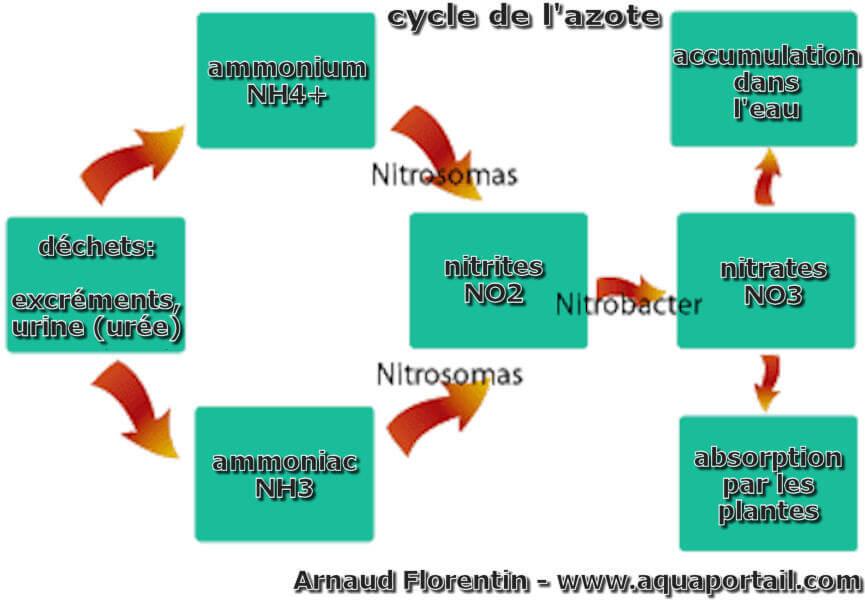
The nitrogen cycle involves 6 steps to break down metabolic waste produced by living organisms in the aquarium.
To kick-start the nitrogen cycle, introduce a small organic waste source such as a piece of cooked mussel or a lettuce leaf, and track the progression of nitrogen compounds as shown in the curve below.
Once the nitrite spike has dropped back to zero, you can begin adding your first fish.
As noted earlier, maintaining healthy water quality requires regular partial water changes.
Beneficial bacteria colonize all surfaces in the aquarium, with the highest concentration living inside your filter media. Never clean all filter media at the same time.
D. Introducing fish
Once the biological cycle is complete, you can introduce the fish selected to match your water's pH, GH, and KH.
To coexist peacefully, tankmates must share compatible water requirements, so always research species before purchasing. When stocking the tank, start with the least territorial species and allow them time to acclimate to their new home.
Fish unsuitable for standard home aquariums: while the list is long, a few commonly sold species should strictly be avoided, notably clown loaches (Botia) and common plecos, which grow to massive adult sizes exceeding 50 cm.